
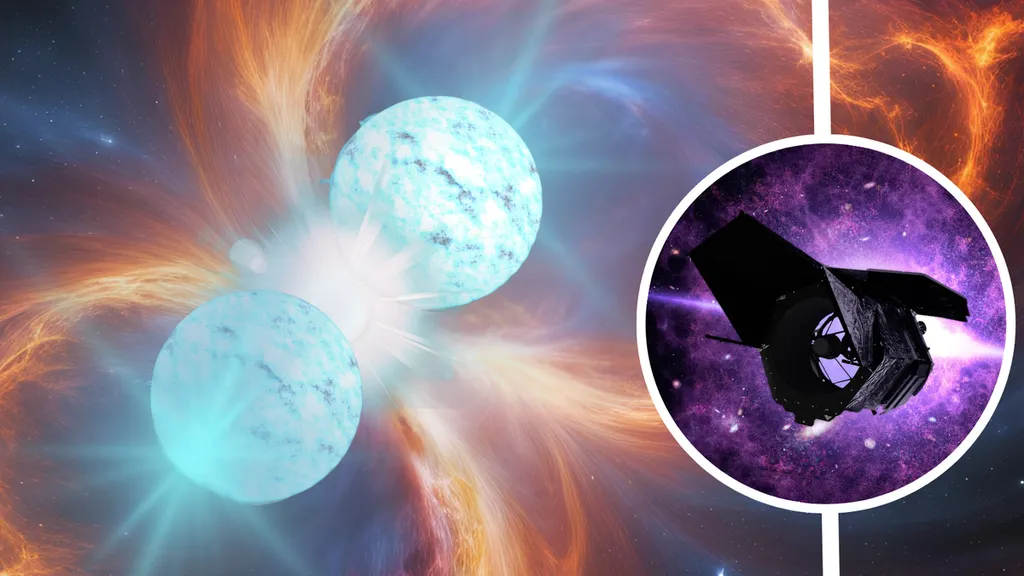
In the realm of astrophysics, a group of researchers led by Nikhil Sarin from the University of Leicester, along with collaborators from various institutions including the University of Warwick, Radboud University, and Monash University, are looking ahead to the 2040s to explore the potential of studying relativistic transients, such as gamma-ray bursts (GRBs) and other cosmic explosions. These phenomena, which are among the brightest in the universe, serve as natural laboratories for extreme physics and tools for probing the early universe.
The researchers highlight that the 2040s will bring significant advancements in observational capabilities. Wide-field optical surveys are expected to discover tens of thousands of optical transients nightly, while proposed high-energy missions like THESEUS could provide 10 to 100 times improved high-energy monitoring. Additionally, third-generation gravitational wave detectors are anticipated to identify hundreds of thousands of compact object mergers annually, many of which will be accompanied by relativistic jets. These industrial-scale discovery rates will enable population studies that address fundamental questions about jet launching mechanisms, nucleosynthesis, the first stars, and how progenitor environments shape these transients across cosmic time.
However, the researchers point out a critical bottleneck: these transients evolve rapidly, with their physics encoded in rapidly-changing multi-wavelength signatures that demand immediate spectroscopic characterization down to a magnitude of 25. Current facilities, optimized for classical or queue scheduling, do not provide the rapid, flexible, multi-target response necessary for industrial-scale follow-up. The researchers argue that without a dedicated large-aperture (10-30 meter effective collecting area) time-domain facility with robotic scheduling and optical-NIR spectroscopic capabilities, the transformative potential of relativistic transient science in the 2040s will be considerably limited.
The research was published in the Bulletin of the American Astronomical Society, outlining the need for advanced facilities to fully realize the scientific potential of relativistic transients in the coming decades. This work underscores the importance of investing in next-generation astronomical infrastructure to keep pace with the anticipated surge in discoveries and to address fundamental questions in astrophysics.
This article is based on research available at arXiv.