
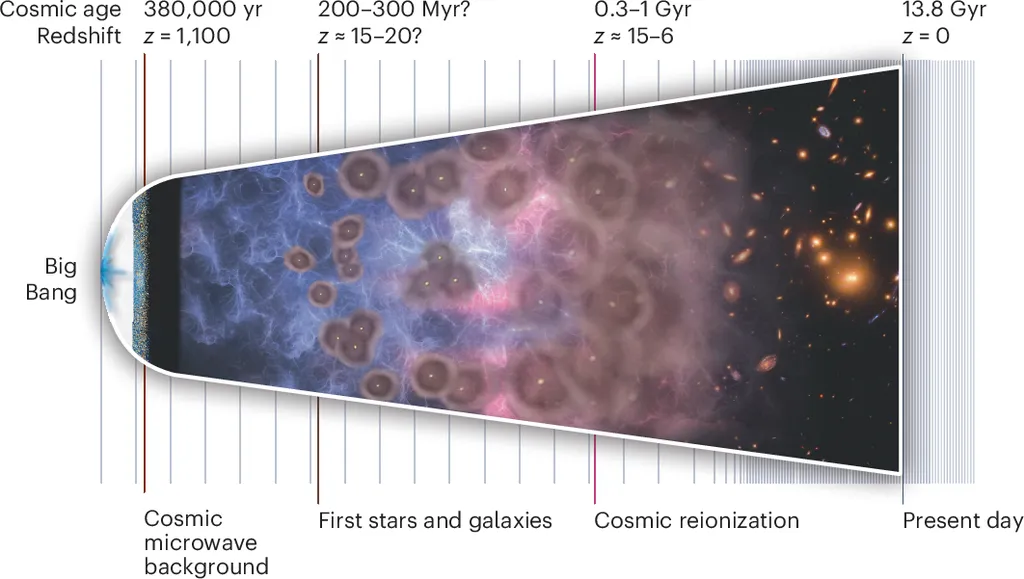
In a recent study, researchers Anirban Roy, Anthony Pullen, Patrick C. Breysse, and Rachel S. Somerville from the Flatiron Institute and the University of California, Berkeley, have explored new methods to investigate the epoch of reionization (EoR), a crucial period in the universe’s history when the first stars and galaxies began to form. Their work, published in the journal Physical Review D, focuses on the potential of combining different astronomical observation techniques to better understand this epoch and its implications for the energy industry.
The epoch of reionization marks the transition of the universe from a neutral state to an ionized one, driven by the radiation from the first stars and galaxies. Understanding this process is essential for comprehending the formation and evolution of these early cosmic structures. The researchers investigated two main techniques: 21 cm line intensity mapping, which probes the neutral hydrogen content in the intergalactic medium, and multi-line intensity mapping (LIM) of atomic and molecular lines like [CII] and CO transitions. These lines provide insights into star formation history, metallicity, and the physical conditions within galaxies.
The study highlights the complementary nature of these techniques. By cross-correlating the 21 cm signal with multi-line intensity mapping data, the researchers found that they could enhance the detectability of signals and constrain key parameters related to reionization. For instance, the cross-correlation between the [CII] line and the 21 cm signal can help measure the ionization fraction across multiple redshift bins, providing a more detailed picture of the reionization history. The researchers used mock observations from the Square Kilometre Array (SKA)-low 21 cm and Fred Young Submillimeter Telescope (FYST)-like LIM experiments to demonstrate the potential of these cross-correlations.
The practical applications of this research for the energy industry lie in the broader understanding of star formation and galaxy evolution. These processes are closely linked to the production and distribution of energy in the universe. By improving our knowledge of the epoch of reionization, we can better understand the conditions that led to the formation of the first stars and galaxies, which are the primary sources of energy in the universe. This knowledge can inform our understanding of energy production and distribution mechanisms, both on cosmic scales and in more localized contexts.
In summary, the study by Roy and colleagues presents a promising approach to investigating the epoch of reionization through the cross-correlation of 21 cm and multi-line intensity mapping signals. Their findings suggest that next-generation experiments like SKA-low and FYST can provide robust constraints on reionization parameters and enhance our understanding of the early universe. This research not only advances our knowledge of cosmic history but also has potential implications for the energy industry by shedding light on the fundamental processes driving energy production and distribution in the universe.
Source: Physical Review D
This article is based on research available at arXiv.