
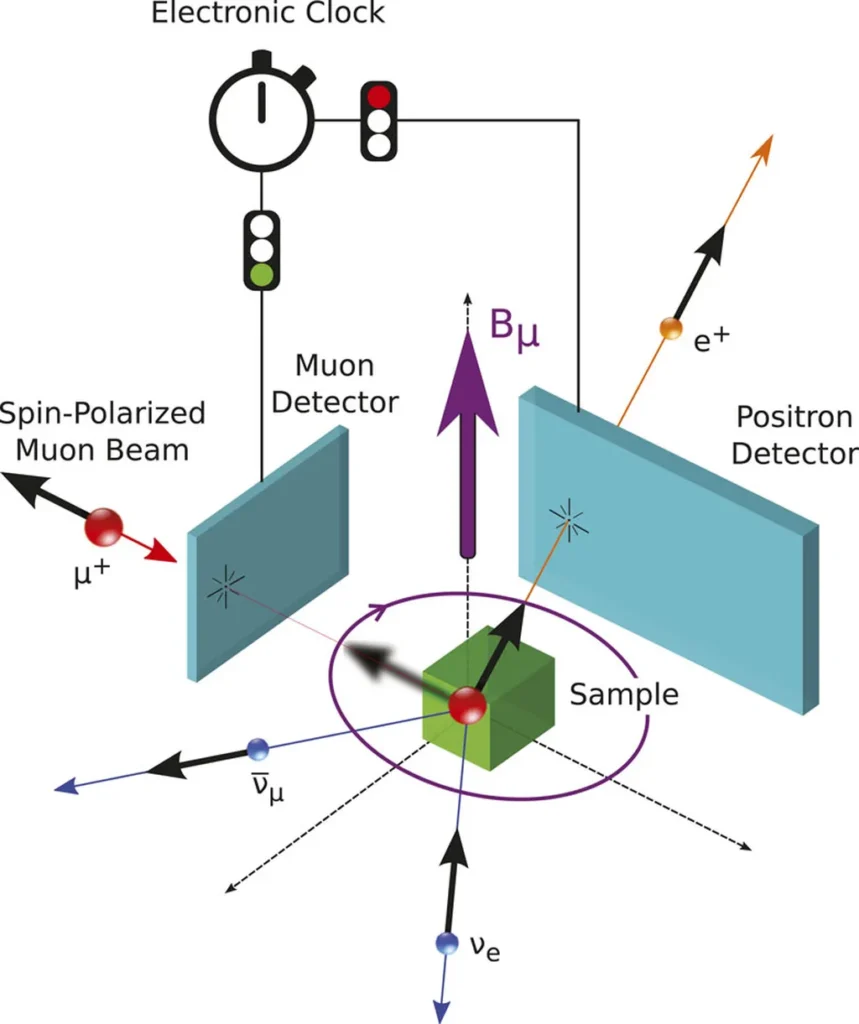
Researchers from Kyoto University, the Paul Scherrer Institute, and other institutions have made significant strides in understanding the superconducting properties of the compound Sr$_2$RuO$_4$ using a technique called muon spin rotation (μSR). This research, published in the journal Nature Communications, offers insights that could be valuable for the energy industry, particularly in the development of advanced superconducting materials for energy transmission and storage.
The team, led by Hisakazu Matsuki and Yoshiteru Maeno from Kyoto University, utilized μSR to measure the internal magnetic field shifts, known as the muon Knight shift, in Sr$_2$RuO$_4$. This technique has been particularly effective in studying heavy-fermion superconductors but has been challenging to apply to d-electron-based superconductors like Sr$_2$RuO$_4$ due to their small Knight shifts.
To overcome this challenge, the researchers employed high-precision μSR measurements and discovered that using multiple crystal pieces, a common practice in μSR measurements, induced a substantial paramagnetic shift below the superconducting transition temperature when a weak magnetic field was applied. This shift was attributed to stray fields generated by neighboring diamagnetic crystals. To avoid this issue, the team used a single crystal piece in their study.
The researchers determined the muon Knight shift of Sr$_2$RuO$_4$ in the normal state to be -116±7 ppm. By combining this observed muon Knight shift with independently determined bulk magnetization data from the same crystal used in μSR, and carefully separating various contributions to the shift, they confirmed a significant reduction in the spin Knight shift below the superconducting transition temperature. This reduction is consistent with spin-singlet-like pairing, a type of electron pairing that is crucial for superconductivity.
The practical applications of this research for the energy sector lie in the development of more efficient and advanced superconducting materials. Superconductors can transmit electricity without resistance, making them highly desirable for energy transmission and storage. Understanding the pairing symmetries and mechanisms in superconductors like Sr$_2$RuO$_4$ can help in the design and development of new materials with improved properties for energy applications.
This study highlights the potential of μSR as a powerful complementary technique to nuclear magnetic resonance for probing the spin susceptibility in superconductors. By providing a deeper understanding of the superconducting state, this research contributes to the ongoing efforts to harness the full potential of superconductors in the energy industry.
This article is based on research available at arXiv.