
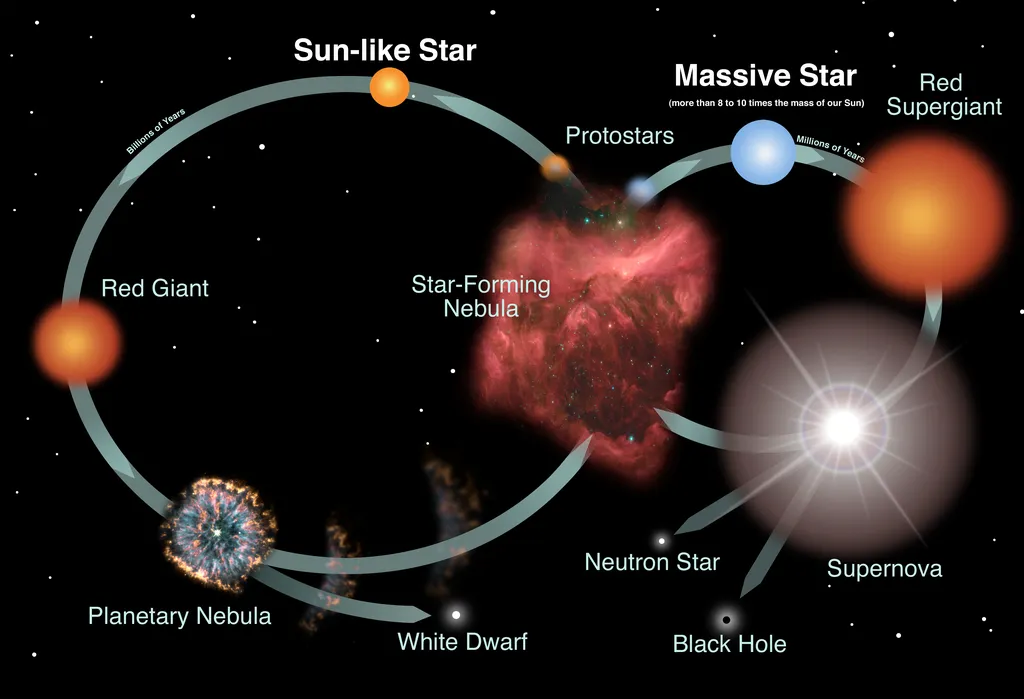
In a recent study, researchers Gautham N. Sabhahit, Jorick S. Vink, and Andreas A. C. Sander from the Argelander Institute for Astronomy at the University of Bonn have shed new light on the mass-loss rates of Very Massive Stars (VMSs), a critical factor in understanding their evolution and ultimate fate. Their findings, published in the journal Astronomy & Astrophysics, have significant implications for the energy sector, particularly in nuclear fusion research and astrophysics-related energy technologies.
The team investigated a phenomenon predicted by Monte Carlo simulations, known as the “wind kink,” where the mass-loss rate of VMSs increases sharply as their winds transition from optically thin to optically thick. This transition is crucial because it marks a shift in the spectral morphology of the stars, from O types to WNh types. The researchers used the PoWR$^\mathrm{HD}$ code to calculate hydrodynamically consistent, non-LTE atmosphere models, creating a grid that spanned stellar masses from 40 to 135 solar masses and temperatures from 12,000 to 50,000 Kelvin.
Their models confirmed the existence of the wind kink, locating it at a critical point where the wind optical depth crosses unity. This point coincides with the transition stars in the Galactic Arches cluster and reproduces a previously predicted model-independent transition mass-loss rate. Importantly, the researchers found that above the kink, mass-loss rates scale much more steeply with decreasing mass, in qualitative agreement with Monte Carlo predictions.
The study also identified two bistability jumps in the mass loss driven by iron ionization shifts. The first occurs near 25,000 Kelvin as iron transitions from FeIV to FeIII, and the second near 15,000 Kelvin as it transitions from FeIII to FeII. These findings provide the first comprehensive confirmation of the VMS mass-loss kink and establish a mass-loss relation with complex mass and temperature dependencies.
For the energy sector, this research is particularly relevant to nuclear fusion efforts, as understanding the evolution and behavior of massive stars can provide insights into the processes that govern stellar energy production. Additionally, the study’s findings can inform astrophysics-related energy technologies, such as those that harness the power of stellar winds or seek to replicate stellar conditions for energy generation. By improving our understanding of VMS mass-loss rates, this research contributes to the broader goal of advancing energy technologies inspired by astrophysical phenomena.
This article is based on research available at arXiv.