
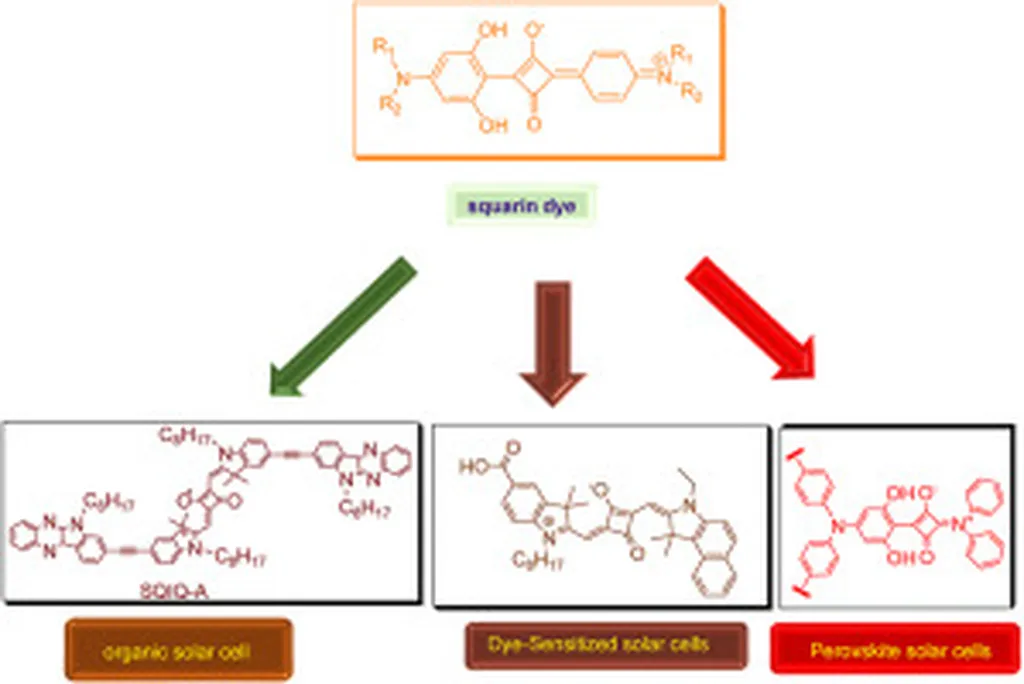
Researchers from the University of Graz, Austria, and the University of Florence, Italy, have delved into the optical properties of squaraine dyes, a class of compounds often considered for light-based applications. The team, led by Narges Taghizade and Markus Koch, has expanded the understanding of these molecules by exploring their behavior not just in the visible light range, but also in the ultraviolet spectrum, up to 6.5 eV.
Squaraine dyes are known for their strong absorption in the visible light range, making them potential candidates for various applications in the energy sector, such as photovoltaics and light-emitting devices. However, their behavior in the ultraviolet range has remained largely unexplored. This research aims to fill that gap by providing a comprehensive map of the optical landscape of a specific squaraine molecule, N-isobutyl substituted anilino-squaraine (SQIB).
The researchers employed a combination of experimental techniques and theoretical methods to achieve this. They extended ground-state and excited-state absorption spectroscopy of SQIB into the ultraviolet range. To distinguish between different excited state absorption peaks, they used transient absorption anisotropy experiments. To relate experimental features to specific states, they employed a set of ab initio methods including time-dependent density functional theory (TDDFT), the Bethe-Salpeter equation (BSE), and n-electron valence perturbation theory on top of a self-consistent complete active space (CASSCF/NEVPT2). Their assignment was complemented by vibronic simulations and a discussion of two-photon absorption measurements.
Through this multidisciplinary approach, the researchers were able to assign a total of twelve electronically excited states to their experimental data. This provides a consistent picture of the optical behavior of SQIB across the visible and ultraviolet light regime. This detailed understanding could help in the design and optimization of squaraine-based materials for specific applications in the energy sector.
The research was published in the journal “The Journal of Physical Chemistry C,” a publication of the American Chemical Society. The findings could pave the way for more efficient and tailored use of squaraine dyes in light-based energy technologies.
This article is based on research available at arXiv.