
In the realm of quantum technologies, a trio of researchers from the Polish Academy of Sciences—Mateusz Kuniej, Paweł Machnikowski, and Michał Gawełczyk—have made a significant stride towards integrating quantum dots (QDs) into on-chip quantum hybrid systems. Their work, published in the journal Physical Review Letters, introduces a novel method for controlling electron spins in quantum dots using a combination of acoustic and optical fields.
Quantum dots are tiny semiconductor particles that have promising applications in quantum computing and communication. They can trap electrons and use their spin states to encode and process information. However, one of the challenges in using QDs is the weak coupling between the electron spins and the mechanical vibrations, or phonons, in the semiconductor material. This weak coupling hinders the integration of QDs into hybrid systems that use acoustic fields for quantum control and communication.
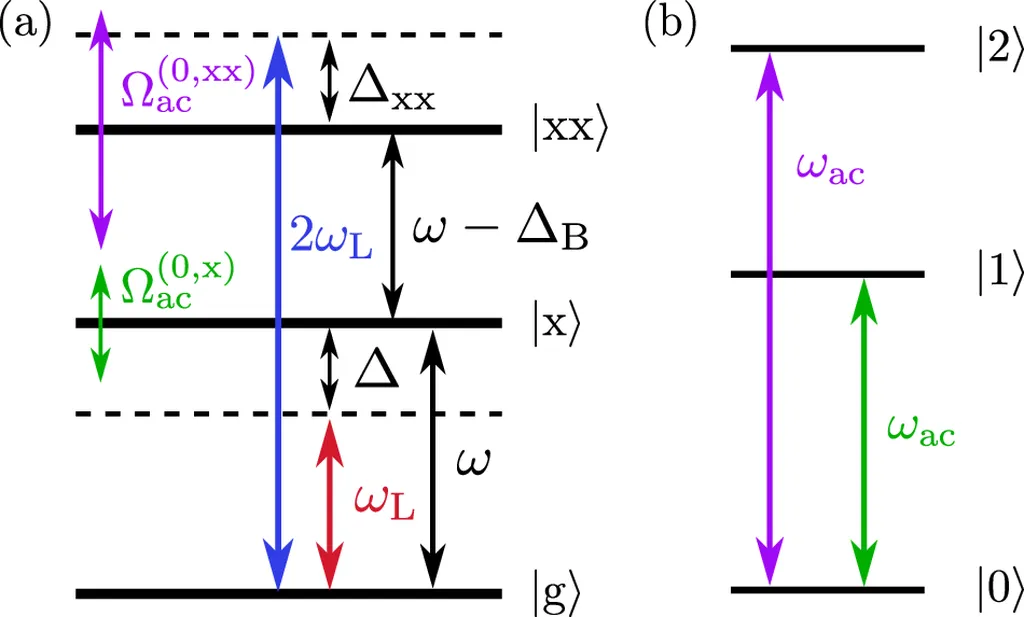
The researchers propose a solution to this problem: a hybrid acousto-optical method for controlling spin states in QDs. The method involves using a continuous optical field to couple the electron spin to a trion state—a state where an electron is bound to a hole in the semiconductor—and an acoustic field to modulate this coupling. The optical field breaks the conservation of spin, allowing the acoustic field to drive transitions between spin states when it is at resonance with the Zeeman frequency—the frequency at which the spin precesses in an external magnetic field.
The researchers’ numerical simulations show that this method can achieve high-fidelity spin rotation, with a fidelity of 99.9% achievable under currently feasible conditions. This high fidelity is crucial for the accurate manipulation of quantum information. Moreover, the method is compatible with pulse sequences that mitigate the effects of noise, making it robust against decoherence.
The practical applications of this research for the energy sector, particularly in quantum technologies, are significant. Quantum technologies promise more efficient and secure ways of processing and transmitting information, which could revolutionize the energy industry. For instance, quantum communication systems could enable ultra-secure transmission of data between energy infrastructure, while quantum sensors could improve the monitoring and control of energy systems. The integration of QDs into on-chip hybrid systems, enabled by this research, could bring us closer to realizing these quantum technologies.
In conclusion, the hybrid acousto-optical spin control method proposed by Kuniej, Machnikowski, and Gawełczyk represents a significant advancement in the field of quantum technologies. By overcoming the challenge of weak spin-phonon coupling in quantum dots, this method paves the way for the integration of QDs into on-chip quantum hybrid systems, with potential applications in the energy sector and beyond.
This article is based on research available at arXiv.