
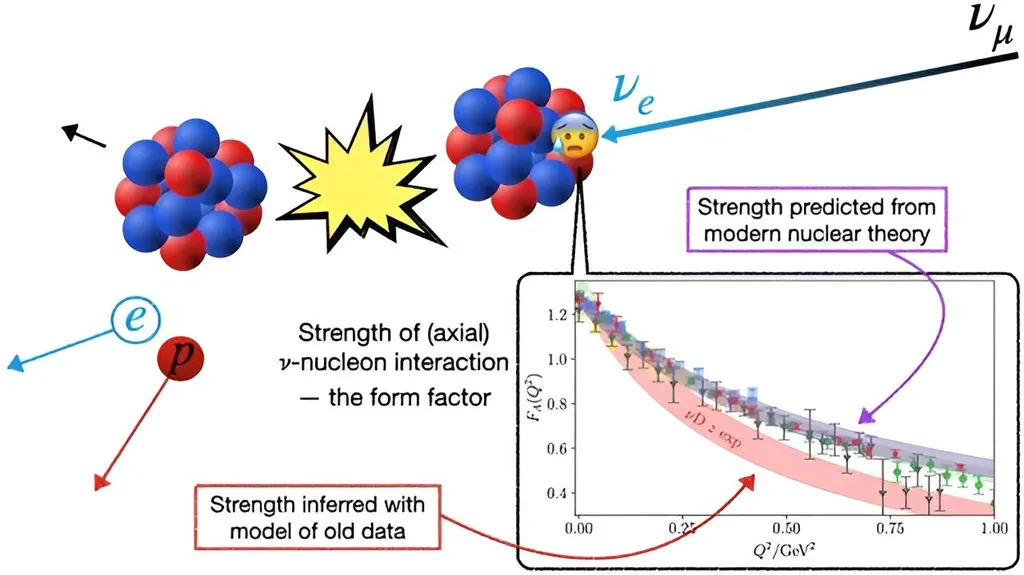
In the realm of energy research, a team of scientists led by Dr. Andrew Meyer from the University of Rochester, along with collaborators from various institutions including the University of Minnesota, the University of Pittsburgh, and the University of Manchester, have been delving into the intricacies of neutrino interactions. Their work, recently published in the journal Physical Review D, focuses on improving our understanding of the nucleon axial form factor, a critical component in predicting neutrino event rates in long-baseline neutrino oscillation experiments.
Neutrinos, often referred to as “ghost particles,” are fundamental to our understanding of the universe, but they are notoriously difficult to study due to their weak interactions with matter. One of the most common interactions, quasielastic scattering, involves a neutrino striking a nucleon (a proton or neutron) and producing two final state particles. The nucleon axial form factor, denoted as FA(Q2), is a key player in this process, yet it remains a significant source of uncertainty.
The researchers examined data from neutrino scattering experiments on deuterium targets, predictions from Lattice QCD (Quantum Chromodynamics), and recent data from hydrogen targets collected by the MINERvA Collaboration. They found a notable discrepancy between the data obtained from hydrogen and deuterium targets, suggesting that extractions from deuterium may underestimate both the central value and uncertainty of the form factor.
To address this, the team provided new parameterizations for the nucleon axial form factor using the z expansion, a mathematical technique that offers a more precise description of the form factor’s behavior. This improvement is crucial for enhancing the accuracy of predictions in neutrino oscillation experiments, which are pivotal for understanding fundamental aspects of particle physics and the energy landscape.
For the energy sector, a deeper understanding of neutrino interactions can have practical applications. Neutrino detectors, for instance, could be improved to enhance their sensitivity and efficiency, potentially leading to better monitoring of nuclear reactors and more accurate detection of neutrinos produced in nuclear processes. Additionally, this research contributes to the broader field of particle physics, which underpins many technological advancements and energy innovations.
In summary, the work of Dr. Meyer and his colleagues represents a significant step forward in refining our knowledge of neutrino interactions. By improving the nucleon axial form factor, they pave the way for more precise predictions in neutrino oscillation experiments, ultimately benefiting both fundamental research and practical applications in the energy industry. The research was published in Physical Review D, a leading journal in the field of particle physics.
This article is based on research available at arXiv.