
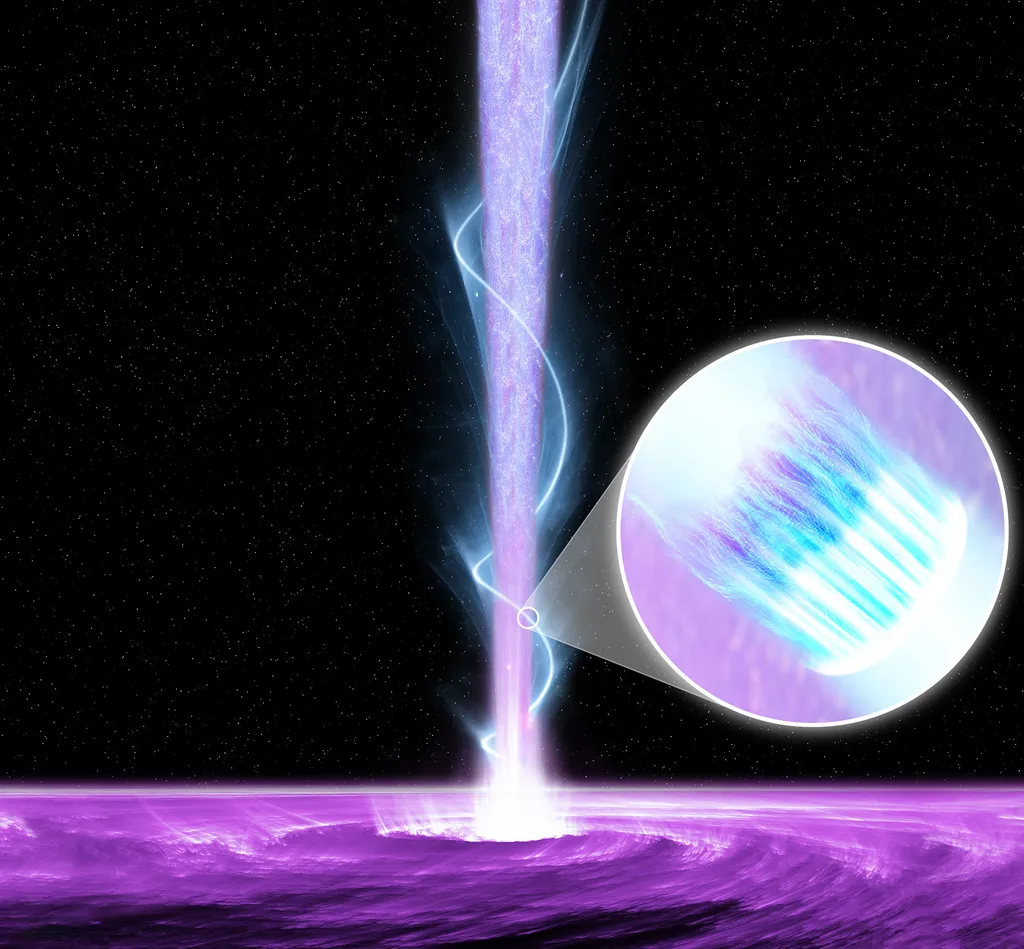
In the realm of astrophysics, a trio of researchers from the Department of Physics at the National and Kapodistrian University of Athens, Greece, have made significant strides in understanding the enigmatic behavior of blazars. Stella Boula, Apostolos Mastichiadis, and Demosthenes Kazanas have developed a model that sheds light on the complex emission processes of these powerful cosmic objects, potentially offering insights that could influence our understanding of energy production and transfer in the universe.
Blazars are a subclass of active galactic nuclei (AGN) characterized by their intense, variable, and non-thermal radiation across the electromagnetic spectrum. The physical mechanisms behind their emission and the so-called “blazar sequence” have remained elusive. The researchers’ new model, published in the journal Astronomy & Astrophysics, presents a self-consistent, two-zone leptonic framework that addresses these open questions.
The model posits that relativistic electrons accelerate in a compact region, losing energy through synchrotron and inverse Compton processes. These electrons then escape into a larger zone, where they interact with an external photon field associated with magnetohydrodynamic winds from the accretion disk. By varying only the mass accretion rate onto the central black hole, the model naturally reproduces the blazar sequence, including key parameters such as Compton Dominance, gamma-ray spectral indices, and the positions of synchrotron and inverse Compton peaks.
The researchers found that variations in secondary parameters account for the observed spread in blazar data. For instance, Flat Spectrum Radio Quasars exhibit strong external Compton emission from the extended zone, while BL Lac objects are dominated by synchrotron and synchrotron self-Compton emission from the compact acceleration region. This framework underscores the pivotal role of accretion rate and spatially structured emission zones in shaping blazar spectra, providing a unified interpretation of their diverse phenomenology.
While this research is primarily astrophysical in nature, it offers valuable insights for the energy sector. Understanding the mechanisms of energy production and transfer in extreme environments like blazars can inspire innovative approaches to energy generation and management on Earth. The model’s emphasis on the role of accretion rates and structured emission zones could inform the development of more efficient and sustainable energy technologies, particularly in the fields of nuclear and renewable energy.
Moreover, the study’s findings could have implications for space-based solar power systems, which aim to capture solar energy in space and transmit it to Earth. By enhancing our comprehension of energy transfer processes in astrophysical contexts, this research contributes to the broader goal of advancing energy technologies that are both efficient and environmentally friendly.
In summary, the work of Boula, Mastichiadis, and Kazanas represents a significant step forward in our understanding of blazars and their emission processes. Their model not only provides a unified interpretation of blazar phenomenology but also offers valuable insights for the energy sector, highlighting the potential for cross-disciplinary collaboration in the pursuit of sustainable energy solutions.
This article is based on research available at arXiv.