
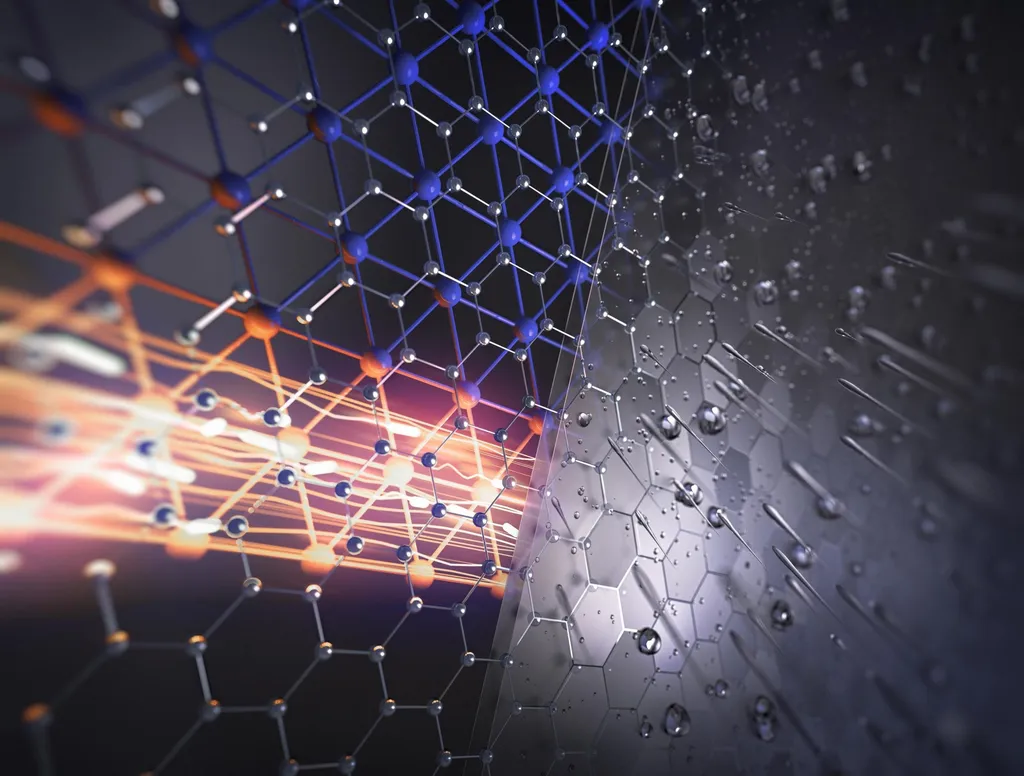
In the realm of quantum technologies, researchers Myung-Chul Jung and Nojoon Myoung from the University of California, Berkeley, are exploring innovative ways to manipulate quantum information using graphene, a single layer of carbon atoms. Their recent study, published in the journal Physical Review Letters, delves into the potential of strain-engineered graphene for spin-based quantum technologies, which could have significant implications for the energy sector’s pursuit of advanced, efficient computing and sensing technologies.
Graphene, known for its exceptional electron mobility and spin coherence, is an attractive platform for quantum technologies. However, integrating spin degrees of freedom into graphene-based quantum devices has been a challenge. Jung and Myoung’s research addresses this by incorporating Rashba spin-orbit coupling (RSOC) and Zeeman fields into strain-engineered graphene p-n junctions. These junctions are created by applying strain to graphene, which generates a pseudo-magnetic field that forms double quantum dots—tiny regions where electrons can be trapped and manipulated.
The researchers used tight-binding quantum transport simulations and a four-band model to study these quantum dots. They found two distinct types of avoided crossings: spin-conserving gaps at zero detuning and spin-flip gaps at finite detuning. The spin-flip gaps increase with the strength of the spin-orbit coupling, while the spin-conserving gaps decrease. This behavior was confirmed through time-domain simulations, which showed detuning-dependent Rabi oscillations corresponding to these two operational regimes.
The practical applications of this research for the energy sector are promising. Spin-based quantum technologies could lead to more efficient and powerful quantum computers, which could be used to optimize energy grids, improve energy storage systems, and enhance renewable energy integration. Moreover, the ability to manipulate spin qubits in graphene could lead to advanced sensing technologies for monitoring and controlling energy systems.
In summary, Jung and Myoung’s work demonstrates that strain-induced confinement combined with tunable spin-orbit coupling provides a viable mechanism for coherent spin manipulation in pristine graphene. This positions strained single-layer graphene as a promising platform for scalable spin-based quantum technologies, with potential benefits for the energy industry. The research was published in Physical Review Letters, a prestigious journal in the field of physics.
This article is based on research available at arXiv.