
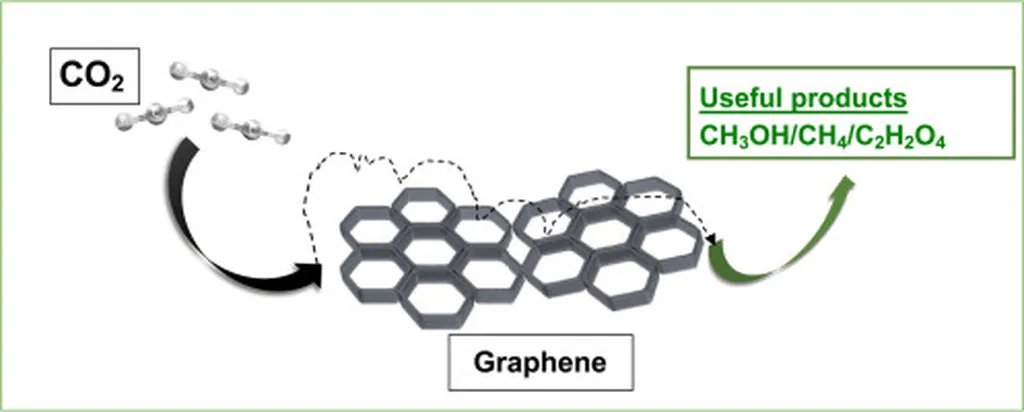
In the realm of energy and environmental science, researchers are continually seeking innovative methods to capture and store carbon dioxide (CO2), a significant greenhouse gas contributing to climate change. Among these researchers is Silvina Gatica, who has been exploring the potential of graphene-based materials for carbon capture. Gatica is affiliated with the Department of Chemical Engineering at the University of Tennessee, Knoxville.
Gatica’s recent study, published in the Journal of Physical Chemistry C, focuses on the adsorption of mixed CO2-water vapors on graphene flakes, a structure inspired by the microporous nature of activated carbons. The research employs molecular dynamics simulations to quantify the adsorption strength and dynamics of CO2 and water molecules on graphene flakes.
The study reveals that CO2 adsorbs more strongly and rapidly than water across all temperatures investigated. Interestingly, the presence of water vapor was found to enhance CO2 uptake at temperatures below 375 Kelvin (approximately 104°C or 220°F). This unexpected finding suggests that humidity may not be the hindrance to carbon capture that it was once thought to be.
At intermediate temperatures, water molecules were observed to form small clusters that interact with both the graphene substrate and CO2 molecules. These clusters appear to facilitate CO2 adsorption, indicating a cooperative adsorption mechanism in humid environments. Furthermore, the graphene flakes were found to inhibit the formation of large water clusters, altering water aggregation dynamics near the surface.
These findings have significant implications for the energy sector, particularly in the development of carbon capture and storage (CCS) technologies. Graphene-flakes-based materials may offer an effective and efficient means of capturing CO2 under realistic, moisture-containing conditions. This could lead to more practical and scalable CCS solutions, which are crucial for reducing greenhouse gas emissions from power plants and industrial facilities.
Moreover, the study’s insights into the cooperative adsorption mechanism could pave the way for the design of novel materials that leverage humidity to enhance carbon capture. This could be particularly beneficial in applications where water vapor is prevalent, such as in flue gas streams from coal-fired power plants or industrial processes.
In conclusion, Gatica’s research provides valuable insights into the complex interactions between CO2, water, and graphene-based materials. By shedding light on the potential benefits of humidity in carbon capture, this study opens up new avenues for the development of advanced CCS technologies. As the energy sector continues to grapple with the challenges of reducing greenhouse gas emissions, such innovations will be instrumental in driving progress towards a more sustainable future.
This article is based on research available at arXiv.