
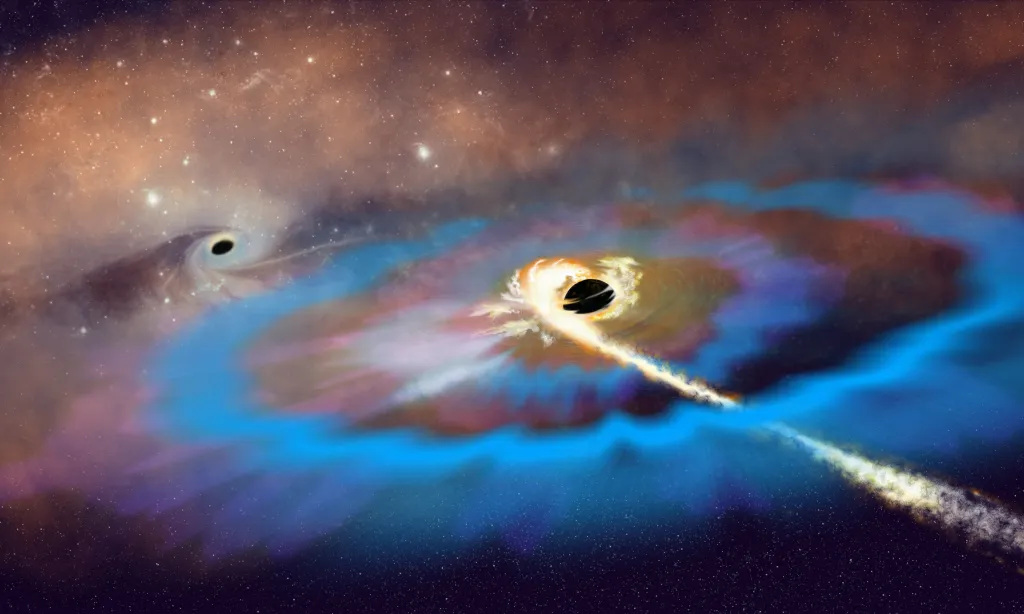
In a recent study, a team of researchers led by Marco Albán from the University of São Paulo, along with Dominika Wylezalek from the University of Oxford, Pranav Kukreti from the University of Florida, and Rogemar and Rogerio Riffel from the Universidade Federal de Santa Maria, investigated the connection between radio emissions and active galactic nuclei (AGN) activity in star-forming galaxies. Their findings were published in the Astrophysical Journal.
The researchers focused on star-forming galaxies that do not show clear signs of current AGN activity. They analyzed data from low-frequency (144MHz) and high-frequency (1.4GHz) radio surveys, combined with spatially resolved spectroscopy from the MaNGA survey. The goal was to compare star-forming galaxies with radio detections at 144 MHz that either do or do not have detections at 1.4 GHz.
The study revealed that star-forming galaxies detected at both 144 MHz and 1.4 GHz exhibit distinct characteristics compared to those detected only at 144 MHz. These differences include enhanced ionized gas-emission line widths, higher central outflow fractions, redder colors, increased central obscuration, and emission-line ratios that shift towards the AGN regime. The researchers also found that the galaxies detected at 1.4 GHz are significantly more radio compact, while those not detected at 1.4 GHz have extended radio morphologies.
The similarities between the properties of GHz-detected star-forming galaxies and known radio-detected AGNs suggest that the underlying physical mechanisms shaping these galaxies might be fundamentally similar. This raises intriguing questions about whether some compact star-forming galaxies represent a precursor phase of AGN evolution or a form of low-power AGN. The researchers also noted a potential connection between AGN and old starburst galaxies based on the compact radio characteristics of the GHz-detected star-forming galaxies.
For the energy sector, this research highlights the importance of understanding the different sources of radio emissions in galaxies. This knowledge can help in developing more accurate models for energy production and consumption in the universe, as well as in identifying potential sources of renewable energy. Additionally, the study’s findings could contribute to the development of new technologies for radio astronomy, which can be used to monitor and predict space weather events that may impact energy infrastructure on Earth.
This article is based on research available at arXiv.