
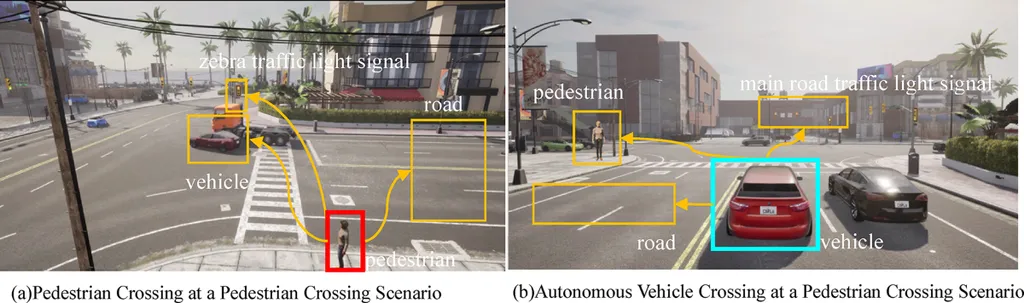
Researchers Dereje Shenkut and Vijayakumar Bhagavatula from the University of Texas at Austin have developed a novel approach to improve the safety of autonomous driving systems, particularly for vulnerable road users like pedestrians. Their work, titled “FocalComm: Hard Instance-Aware Multi-Agent Perception,” focuses on enhancing the collaborative perception capabilities of autonomous vehicles.
Multi-agent collaborative perception (CP) is a technique that allows autonomous vehicles to share and combine sensory data to improve their understanding of the environment. While existing CP methods have shown promise, they often prioritize the detection of larger objects like vehicles, potentially overlooking smaller, safety-critical objects such as pedestrians. Moreover, these methods typically exchange all features, which can be inefficient and may not effectively reduce false negatives.
To address these challenges, Shenkut and Bhagavatula present FocalComm, a new collaborative perception framework designed to focus on exchanging features related to hard-to-detect instances, such as pedestrians. The framework consists of two key components: a learnable progressive hard instance mining (HIM) module that extracts features specific to challenging instances, and a query-based feature-level fusion technique that dynamically weights these features during collaboration.
The researchers evaluated FocalComm on two real-world datasets, V2X-Real and DAIR-V2X, under both vehicle-centric and infrastructure-centric collaborative setups. Their results demonstrate that FocalComm outperforms state-of-the-art collaborative perception methods, particularly in pedestrian detection. This improvement could significantly enhance the safety of autonomous driving systems, especially in urban environments where interactions with pedestrians are frequent.
The practical applications of this research extend beyond autonomous vehicles. In the energy sector, similar multi-agent perception techniques could be applied to improve the safety and efficiency of autonomous inspection systems used in power plants, wind farms, and other energy infrastructure. By enhancing the ability of these systems to detect and avoid obstacles, including small or hard-to-see objects, energy companies could reduce downtime, prevent accidents, and lower maintenance costs.
The research was published in the Proceedings of the IEEE/CVF Conference on Computer Vision and Pattern Recognition (CVPR), a premier international conference in the field of computer vision.
This article is based on research available at arXiv.