
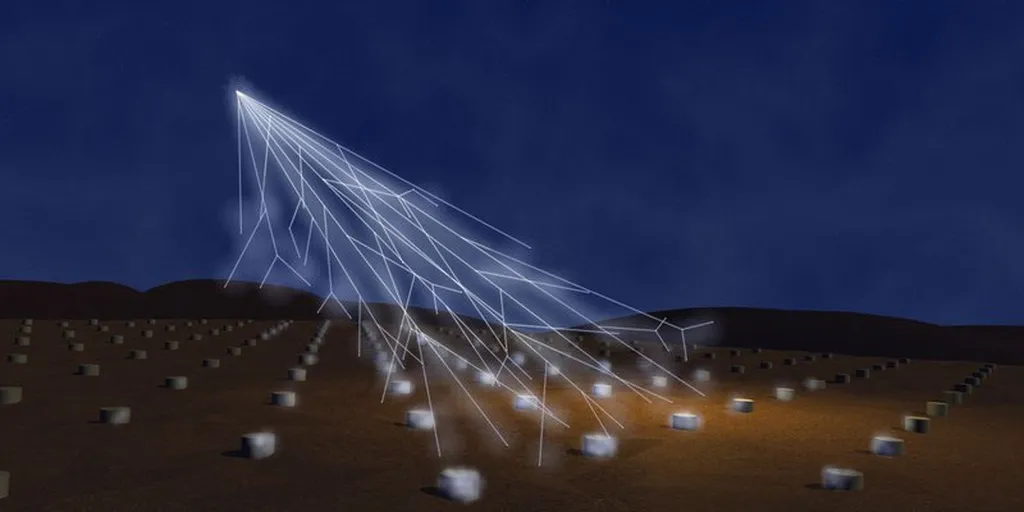
In the realm of energy and particle physics, researchers like Eva dos Santos from the Pierre Auger Observatory are delving into the mysteries of ultra-high-energy cosmic rays. These cosmic rays, with energies exceeding 10^18 eV, interact with the Earth’s atmosphere to create extensive air showers. The Pierre Auger Observatory, a pioneering research endeavor, has been studying these interactions for over two decades, providing unique insights into hadronic interactions at energies far beyond what human-made particle accelerators can achieve.
The Pierre Auger Observatory has been instrumental in probing hadronic interactions at the 100 TeV center-of-mass energy scale. By analyzing the extensive air showers produced by ultra-high-energy cosmic rays, researchers have identified a notable discrepancy in current models of hadronic interactions. Specifically, these models predict a muon deficit that becomes more pronounced with increasing energy when compared to actual measurements. This tension between predictions and observations is particularly evident in the interpretation of the nuclear mass composition derived from the muon content of air showers, which does not align with direct measurements of the depth of the maximum of electromagnetic profiles.
However, the measured fluctuations of the muon content of air showers are consistent with model predictions. This suggests that the discrepancies arise from small, cumulative deviations in the hadronic models throughout the entire shower development, rather than from large errors in the calculation of the initial hadronic interactions. To address this muon deficit, researchers have proposed a data-driven approach that involves shifting the predicted depth of the maximum of air-shower profiles by 30-50 g/cm² towards a heavier mass composition. This adjustment helps to alleviate the observed muon deficit.
In addition to these findings, the Pierre Auger Observatory has recently provided an updated measurement of the proton-proton cross-section at a center-of-mass energy of 57 TeV. Furthermore, the Observatory’s upgrade, known as AugerPrime, has enabled the first estimates of the neutron content of air showers by analyzing late-time signals from surface scintillator detectors. With the advent of AugerPrime, researchers anticipate delivering breakthrough results on hadronic interactions at the 100 TeV scale in the coming decade.
The research conducted by Eva dos Santos and her colleagues at the Pierre Auger Observatory has significant implications for the energy sector, particularly in the field of nuclear and particle physics. By improving our understanding of hadronic interactions at ultra-high energies, these findings can contribute to the development of more accurate models and simulations. This, in turn, can enhance our ability to design and optimize particle accelerators and other energy-related technologies. The research was published in a recent issue of the journal Physical Review D, highlighting the ongoing efforts to unravel the complexities of cosmic rays and their interactions with the Earth’s atmosphere.
This article is based on research available at arXiv.