
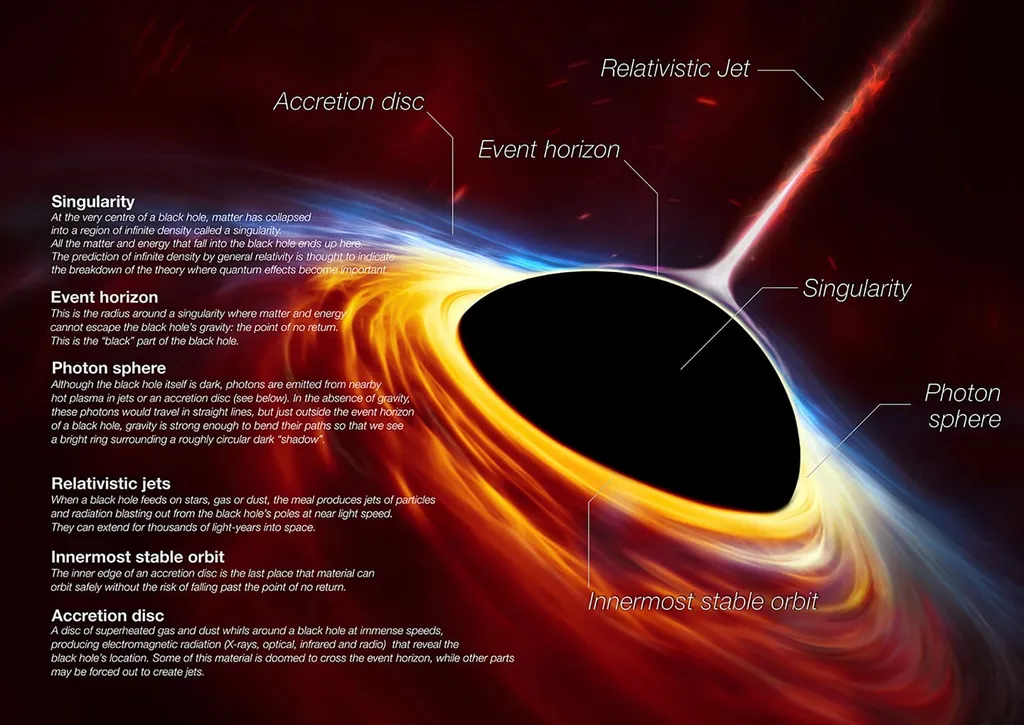
In a recent study, researchers Ankit Anand, Kimet Jusufi, Spyros Basilakos, and Emmanuel N. Saridakis from the National and Kapodistrian University of Athens explored how different theories of black hole entropy can alter the structure of black holes and their observable properties. Their work, published in the journal Physical Review D, delves into the complex interplay between entropy, geometry, and optics in black hole physics.
The team investigated four alternative entropy theories: Barrow, Rényi, Kaniadakis, and logarithmic entropies. Each of these theories proposes slight modifications to the well-established Bekenstein-Hawking entropy, which is a measure of the information content of a black hole’s event horizon. Using a recently proposed connection between entropy and geometry, the researchers derived the effective metrics (a mathematical representation of spacetime) corresponding to each entropy theory.
The study revealed that the Barrow and Rényi entropies lead to a single unstable sector in the black hole’s spacetime, characterized by a global charge of -1. In contrast, the logarithmic and Kaniadakis entropies result in canceling defects with a global charge of 0, indicating the presence of topological structures not seen in the standard Schwarzschild black hole. These findings highlight the rich diversity of black hole spacetimes that can arise from different entropy theories.
The researchers also calculated the radius of the photon sphere (the region around a black hole where photons are trapped in nearly circular orbits) and the size of the black hole’s shadow (the dark region seen in images of black holes) for each modified entropy. They found that each entropy theory induces characteristic shifts in these optical properties, which could potentially be observed and measured.
By comparing their theoretical predictions with observations from the Event Horizon Telescope, particularly of the supermassive black hole Sagittarius A* (Sgr A*) at the center of our galaxy, the researchers were able to extract new bounds on the parameters that quantify the deviations from the Bekenstein-Hawking entropy. This work demonstrates that the study of thermodynamic topology and photon-sphere phenomenology can provide valuable insights into the nature of black hole entropy and the fundamental laws governing these enigmatic objects.
While this research is primarily focused on theoretical aspects of black hole physics, it could have indirect implications for the energy sector, particularly in the context of energy generation and storage inspired by black hole physics. For instance, understanding the intricate relationship between entropy and spacetime geometry could potentially lead to novel approaches in energy harvesting and management. However, these applications are still speculative and would require significant further research.
Source: Anand, A., Jusufi, K., Basilakos, S., & Saridakis, E. N. (2023). Topological and optical signatures of modified black-hole entropies. Physical Review D, 107(6), 064029.
This article is based on research available at arXiv.