
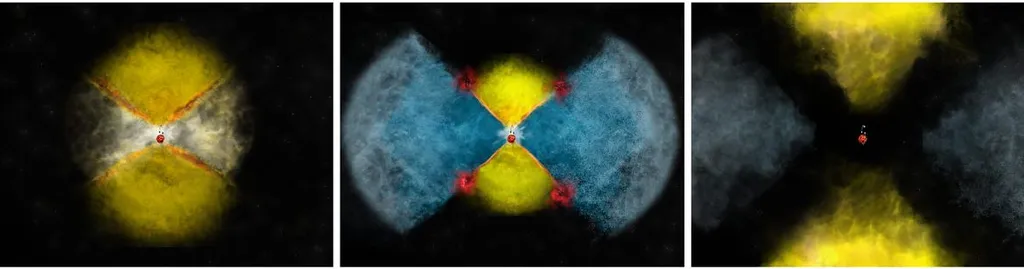
In the realm of astrophysics, researchers like Yusuke Tampo from the National Astronomical Observatory of Japan are delving into the mysteries of WZ Sge-type dwarf novae, a fascinating class of compact binary stars. These systems, part of the cataclysmic variable family, are known for their dramatic outbursts and decade-long cycles. Tampo’s recent review paper, published in the Proceedings of the International Astronomical Union, sheds light on the latest findings and unresolved questions surrounding these enigmatic objects.
WZ Sge-type dwarf novae are recognized as the most evolved population of hydrogen-rich cataclysmic variables. These systems consist of a white dwarf primary star and a low-mass secondary star, typically a red dwarf. Material from the secondary star is drawn onto the white dwarf, forming an accretion disk. Periodically, this disk undergoes a sudden, dramatic increase in brightness, known as an outburst. These outbursts can be as bright as 6-9 magnitudes and last for about a month, with cycles occurring roughly once a decade.
Recent observations have challenged some of the traditional understandings of these outbursts. Photometric and spectroscopic data have shown an absence of enhanced emission from the hotspot during the early outburst rise. This finding casts doubt on the occurrence of enhanced mass transfer, a previously accepted mechanism for these outbursts. Instead, researchers are now exploring alternative explanations, such as the influence of a magnetic white dwarf, which could truncate the inner disk in quiescence.
Moreover, diversity among WZ Sge-type dwarf novae systems has been discovered. Some systems exhibit superoutbursts both with and without an early superhump phase, while others may harbor an oxygen-neon-magnesium (ONe) and massive white dwarf. Additionally, some systems show optical spectra strongly affected by disk winds. These findings highlight the complexity and variability within this class of objects.
Tampo’s review also explores the connections between WZ Sge-type dwarf novae and other types of compact binaries, such as period bouncers, helium-rich AM CVn stars, and low-mass X-ray binaries. Understanding these connections can provide valuable insights into the evolutionary paths and outburst mechanisms of these systems.
Looking ahead, Tampo presents the prospects of studying WZ Sge-type dwarf novae in the upcoming time-domain surveys, such as the Rubin Observatory Legacy Survey of Space and Time (LSST). These surveys promise to revolutionize our understanding of these enigmatic objects by providing a wealth of new data.
For the energy sector, the study of WZ Sge-type dwarf novae might seem far removed, but there are potential applications. Understanding the physics of accretion disks and outbursts can inform the development of nuclear fusion technologies, which aim to harness the power of stellar processes for clean energy production. Additionally, the study of compact binaries can contribute to our knowledge of gravitational wave sources, which are of interest for both fundamental physics and potential energy harvesting technologies.
This article is based on research available at arXiv.