
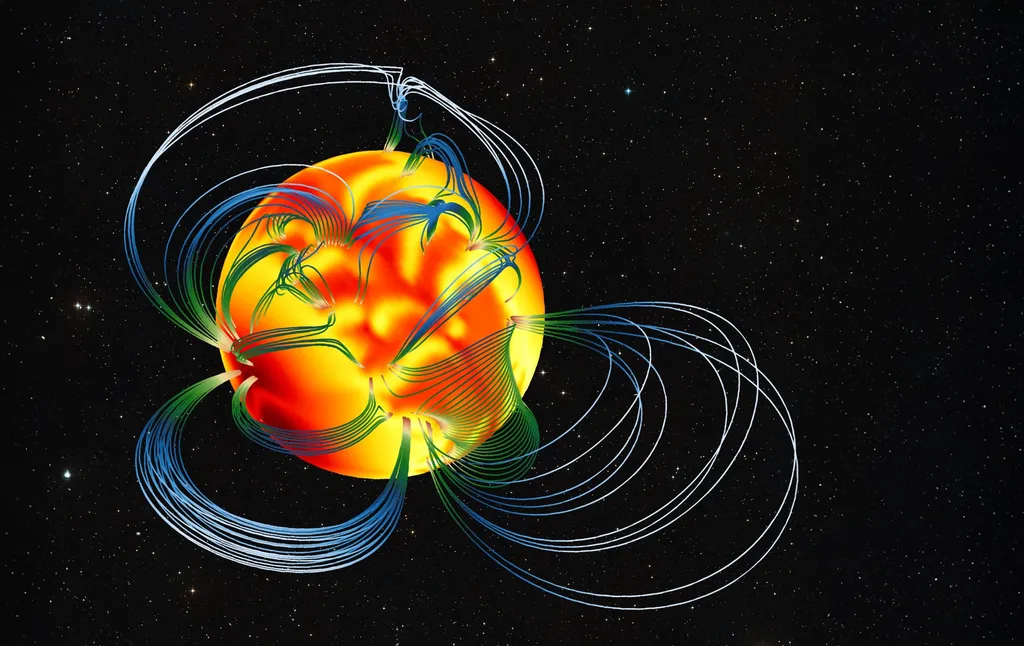
In the realm of astrophysics and energy research, understanding the behavior of magnetic fields in extreme environments like neutron star cores can have profound implications for our understanding of energy dynamics in dense, magnetized systems. Researchers Andrei Igoshev, Nicolás A. Moraga, Andreas Reisenegger, Calum S. Skene, and Rainer Hollerbach, affiliated with institutions including the University of Hull, the University of Concepción, and the University of Leeds, have delved into this complex topic through advanced numerical simulations.
The team’s research, published in the Monthly Notices of the Royal Astronomical Society, focuses on the evolution of magnetic fields within neutron star cores. Neutron stars, the incredibly dense remnants of supernovae, possess intense magnetic fields that are not yet fully understood. The researchers employed three-dimensional numerical simulations to study the behavior of these fields under different fluid dynamics scenarios.
In their study, the researchers considered two primary models: one involving a single barotropic fluid and another involving two collisionally coupled barotropic fluids with distinct density profiles. The single-fluid model describes the motion of charged particles, while the two-fluid model introduces a neutral fluid coupled to an electrically conductive fluid through collisions. This coupling results in a relative motion between the fluids, a phenomenon known as ambipolar diffusion.
Using a code based on Dedalus, a flexible framework for solving differential equations, the team simulated the evolution of simple poloidal dipolar and toroidal magnetic fields. Previous two-dimensional studies had suggested that poloidal magnetic fields evolve towards a stable equilibrium. However, the researchers’ three-dimensional simulations revealed a different outcome. They observed an instability in the two-fluid system, similar to that in the single-fluid system. After the instability saturated, a highly non-linear Lorentz force introduced small-scale fluid motion, leading to turbulence, the development of a cascade, and significant changes in the magnetic field configuration.
The researchers found that fluid viscosity played a crucial role in regularizing the small-scale fluid motion, providing an energy drain that influenced the overall dynamics. This finding highlights the importance of considering three-dimensional effects and the role of viscosity in understanding the evolution of magnetic fields in neutron star cores.
While this research is primarily focused on astrophysical phenomena, the insights gained can have practical applications in the energy sector. Understanding the behavior of magnetic fields in extreme environments can inform the development of advanced energy technologies, such as fusion reactors, which rely on the confinement and control of plasma within intense magnetic fields. The study’s emphasis on the role of turbulence and viscosity in magnetic field dynamics can also contribute to the improvement of energy systems that involve complex fluid dynamics.
In summary, the research conducted by Igoshev, Moraga, Reisenegger, Skene, and Hollerbach sheds light on the intricate behavior of magnetic fields in neutron star cores. Their findings not only advance our understanding of astrophysical processes but also offer valuable insights for the development of advanced energy technologies.
This article is based on research available at arXiv.