
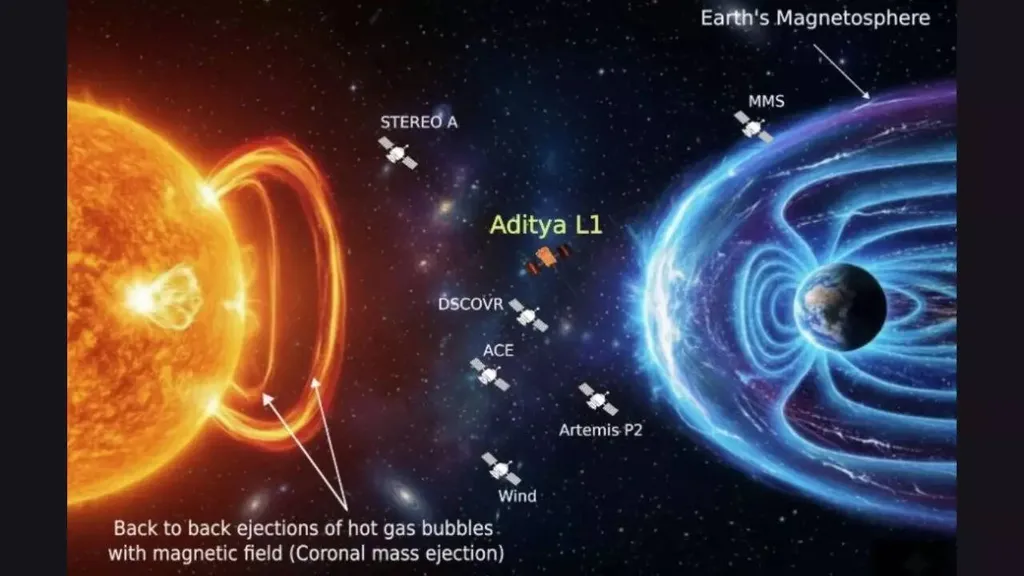
In the realm of solar and space physics, a team of researchers led by Shivam Parashar from the Physical Research Laboratory in India has made a significant observation related to the interaction of solar phenomena that could have implications for space weather and energy systems on Earth. The team, which includes scientists from various institutions, utilized data from India’s Aditya-L1 mission to study a solar event that occurred in May 2024.
The researchers focused on the interaction between two Coronal Mass Ejections (CMEs), which are large expulsions of plasma and magnetic field from the Sun’s corona. These interactions can alter the geo-effectiveness of CMEs, potentially impacting space weather and, consequently, energy infrastructure on Earth. Using the Aditya Solar Wind Particle EXperiment (ASPEX) instrument on board the Aditya-L1 mission, the team gained unprecedented insights into these interactions.
The ASPEX instrument provided energy spectra measurements from two mutually orthogonal top hat analyzers, allowing the researchers to observe the interaction region from two different planes for the first time from the L1 point, a location in space about 1.5 million kilometers from Earth. The study revealed that the interaction between the two CMEs created a special region downstream, spanning over 13 hours, which propagated through the interplanetary medium. This region served as a site for the energization of protons and alpha particles, with particles being distributed from one plane to the other.
The presence of a forward shock and particle energization was confirmed by the energetic particle flux measurements from the SupraThermal and Energetic Particle Spectrometer (STEPS) of ASPEX. These observations provide a unique perspective on how solar wind ions become energized and distributed in a CME-CME interaction region. Understanding these processes is crucial for predicting space weather events, which can potentially disrupt power grids, satellite operations, and other energy systems on Earth.
The research was published in the journal “Geophysical Research Letters,” a publication of the American Geophysical Union. The findings contribute to the broader effort to improve space weather forecasting, which is essential for protecting energy infrastructure and ensuring the reliable operation of technologies that society depends on. As we become more reliant on space-based assets and ground-based energy systems, the need for accurate space weather predictions becomes ever more critical. This research is a step towards that goal, providing valuable data and insights into the complex interactions that occur in the space environment.
This article is based on research available at arXiv.