
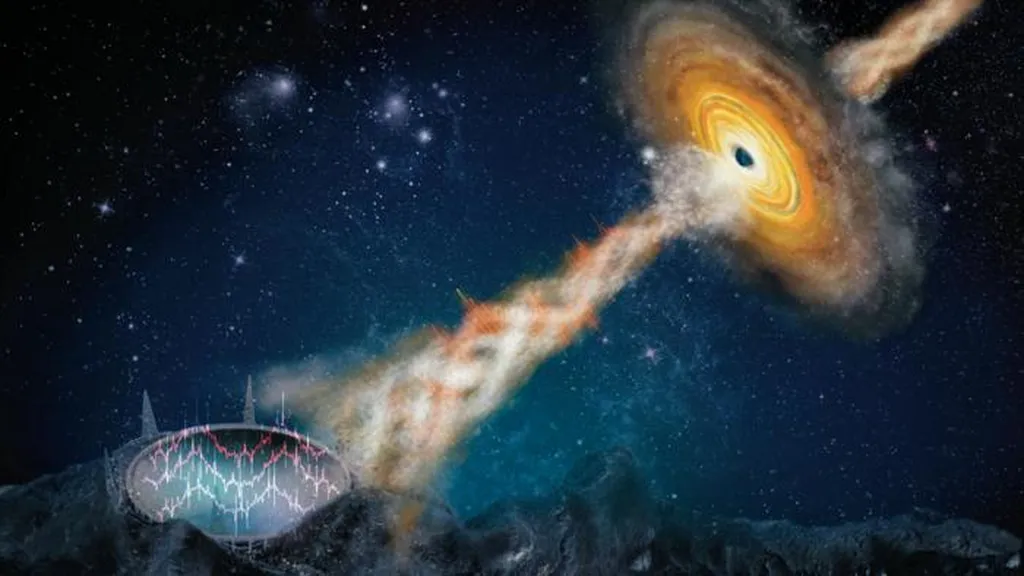
In the realm of astrophysics and energy research, a team of scientists from the Institut de Physique du Globe de Paris and the Institut de Recherche en Astrophysique et Planétologie have been delving into the mysteries of a high-energy nebula surrounding the microquasar V4641 Sgr. The researchers, Maksim Kleimenov, Andrii Neronov, Foteini Oikonomou, and Dmitri Semikoz, have been working to understand the complex interactions within this nebula, which is the brightest known gamma-ray source in the Southern sky at energies exceeding 100 TeV.
The team has developed comprehensive models to explain the observed spectrum and morphology of the nebula. They have explored both leptonic and hadronic scenarios, as well as a combination of the two, known as leptohadronic models. Leptonic models, which involve the interaction of electrons and positrons, are found to be energetically more favorable. However, they require specific morphological assumptions to align with the observed gamma-ray emission.
On the other hand, hadronic models, which involve the interaction of protons and other hadrons, offer a better explanation for the gamma-ray morphology. This is particularly evident when considering the spatial correlation with cold gas structures. Nevertheless, a purely hadronic model would necessitate a substantial energy reservoir in protons and would struggle to account for the extended X-ray emission recently detected by the XRISM satellite.
The researchers have demonstrated that a leptohadronic model, which combines both leptonic and hadronic components, can effectively reproduce the spectral and morphological properties of the nebula. This hybrid approach provides a more comprehensive understanding of the source signal. The team has also provided predictions for the X-ray and neutrino spectra of the nebula, which could help discriminate between the hadronic and leptonic contributions to the overall emission.
This research, published in the journal Astronomy & Astrophysics, offers valuable insights into the complex processes occurring within high-energy nebulae. While the direct applications to the energy industry may not be immediately apparent, the understanding of such extreme environments can contribute to the broader field of plasma physics and high-energy particle interactions, which are relevant to various energy technologies, including fusion research and particle acceleration.
This article is based on research available at arXiv.