
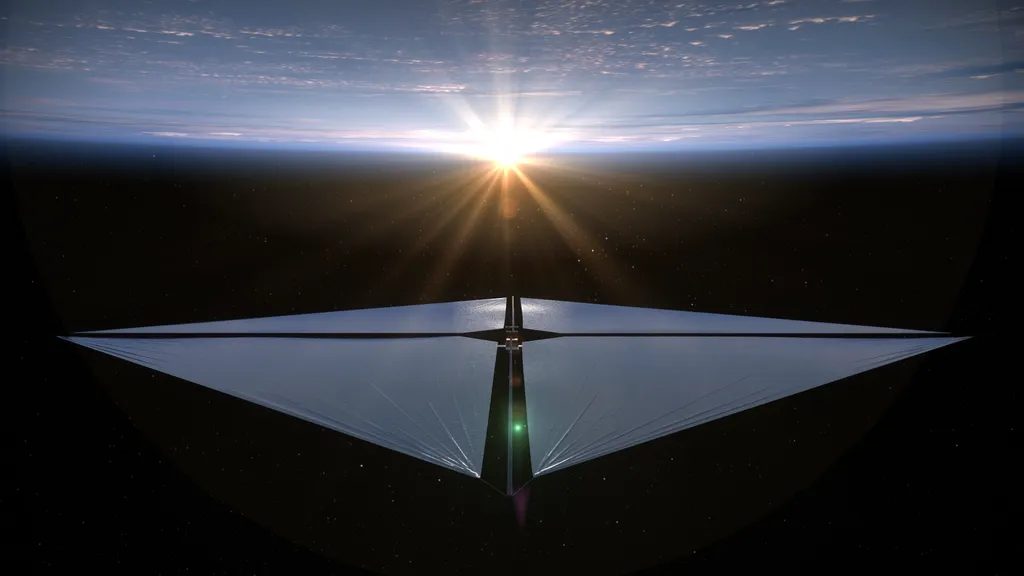
In the quest for innovative propulsion methods for space exploration, researchers Gulzhan Aldan and Igor Bargatin from the University of Pennsylvania have made a significant stride. Their work, published in the journal Advanced Materials Technologies, explores a novel approach to controlling solar sails using a technique inspired by the ancient Japanese art of paper cutting, known as kirigami.
Solar sails are a promising technology for space propulsion, harnessing the momentum of photons from sunlight to generate thrust. However, steering these sails has traditionally required complex and heavy mechanisms. Aldan and Bargatin’s research presents a potentially simpler and lighter solution using kirigami films.
The researchers created buckled aluminized polyimide films perforated with millimeter-scale cuts, forming a kirigami pattern. When stretched, these films can redirect normally incident light at an angle, generating a net in-plane force parallel to the solar sail’s surface. This force can be used to steer the sail without the need for additional control mechanisms.
To validate their concept, the researchers used finite element simulations to predict the buckled shapes of different kirigami unit cell geometries. They then applied ray optics modeling to compute the resulting light-pressure forces. The simulations showed that the buckled kirigami surfaces reflect light in different directions, producing a net in-plane force parallel to the direction of stretching.
Experimental observations confirmed these trends. When a tensioned kirigami sample was illuminated with a laser, the reflected beam patterns matched the predictions from the ray optics simulations. This proof-of-concept study suggests that kirigami films could offer a scalable, low-power, and lightweight method for achieving controllable in-plane forces for solar sail steering.
For the energy sector, particularly in space exploration, this research opens up new possibilities for efficient and lightweight propulsion systems. Solar sails equipped with kirigami films could potentially enable more ambitious missions, reducing the need for heavy and complex control systems. Moreover, the principles demonstrated in this study could inspire further innovations in solar energy harvesting and other light-driven technologies.
The research was published in the journal Advanced Materials Technologies, offering a glimpse into the future of solar sail technology and its potential applications in the energy sector.
This article is based on research available at arXiv.