
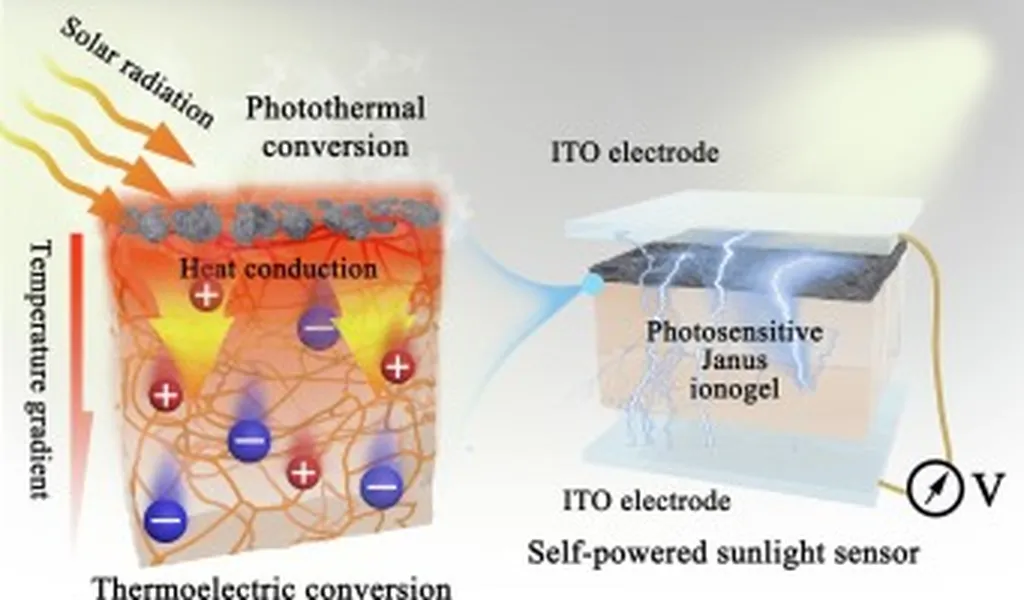
Researchers from the Indian Institute of Technology Hyderabad, including M. Vallinayagam, A. E. Sudheer, and their colleagues, have published a study on the thermoelectric properties of novel two-dimensional materials called Janus layers. Their findings, appearing in the journal Physical Review Materials, could have significant implications for the energy industry, particularly in waste heat recovery and high-temperature power generation.
The researchers investigated a group of materials known as SbXY Janus layers, where X and Y are different elements from the chalcogen (Se, Te) and halogen (Br, I) groups. These materials are unique because they have two different surfaces, which can lead to interesting electronic and thermal properties. Using advanced computational methods, the team found that these materials remain stable at high temperatures, up to 1000 K, making them suitable for applications in harsh environments.
One of the key findings of the study is that the thermal conductivity of these materials is significantly reduced when bromine is present. This is due to enhanced interactions between different types of phonons, which are quantized units of vibrational energy in a material. Lower thermal conductivity is desirable in thermoelectric materials because it helps to maintain a temperature difference, which is crucial for generating electricity from heat.
The electronic structure of these materials was also studied, revealing that they have indirect band gaps of 1.1 to 1.3 eV. This means that they can absorb a wide range of light wavelengths, which could be useful in solar energy applications. The researchers also found that the materials exhibit anisotropic transport, meaning that their properties are different along different directions. This could be exploited to design more efficient thermoelectric devices.
The most promising result from a practical standpoint is the high power factor observed in these materials, particularly in the case of hole-doped SbSeBr. The power factor is a measure of a material’s ability to convert heat into electricity, and the values obtained in this study are on the order of milliwatts per meter-kelvin squared. This is comparable to some of the best thermoelectric materials currently available.
The researchers also calculated the Figure of Merit (ZT), which is a key metric for evaluating the performance of thermoelectric materials. They found that the ZT value reaches 0.6 at 1000 K for hole-doped SbSeBr. While this is still below the values achieved by some state-of-the-art thermoelectric materials, it demonstrates strong potential for further optimization and development.
In terms of practical applications, these findings could lead to the development of more efficient thermoelectric devices for waste heat recovery in industrial processes, as well as for power generation in high-temperature environments. The unique properties of these Janus layers could also open up new avenues for research in the field of thermoelectrics, potentially leading to the discovery of even more advanced materials.
In conclusion, the study by Vallinayagam and colleagues provides valuable insights into the thermoelectric properties of SbXY Janus layers. Their findings highlight the potential of these materials for high-temperature applications and pave the way for further research in this exciting field. As the energy industry continues to seek out more efficient and sustainable solutions, materials like these could play a crucial role in meeting the world’s growing energy demands.
This article is based on research available at arXiv.