
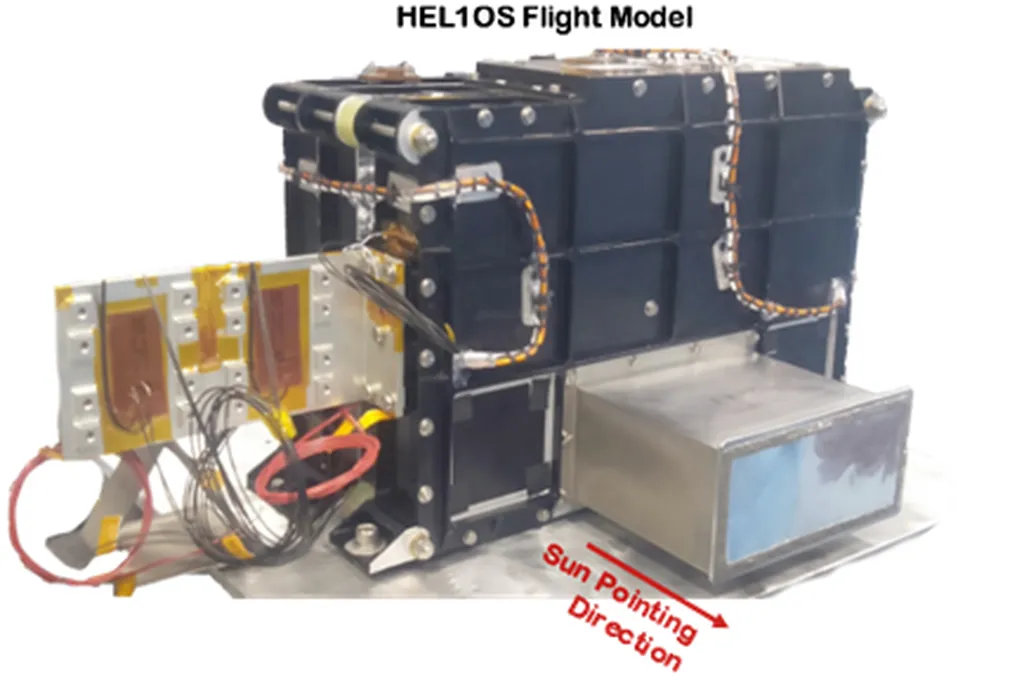
In the realm of solar research and energy forecasting, a team of scientists from various institutions, including the Physical Research Laboratory in India, has developed a novel instrument called HEL1OS (High Energy L1 Orbiting X-ray Spectrometer). This instrument is part of the Aditya-L1 mission, India’s first dedicated solar observatory, which aims to study the sun’s corona and solar flares.
HEL1OS is designed to continuously monitor and measure the time-resolved spectra of solar flares within the energy range of 8 keV to 150 keV. This broad range is covered using two types of compound semiconductor detectors: cadmium telluride (CdTe) for the 8-70 keV range and cadmium zinc telluride (CZT) for the 20-150 keV range. The detectors have geometric areas of 0.5 cm² and 32 cm², respectively. A stainless steel collimator provides a field-of-view of 6° × 6°, optimized to limit off-axis response while adhering to the instrument’s mass constraints.
The instrument’s front-end electronics, designed in-house, uses low-noise digital pulse processing to achieve a spectral resolution of approximately 1 keV at 14 keV for CdTe and approximately 7 keV at 60 keV for CZT. HEL1OS also includes processing and power electronics to handle signal processing, drive the electronics, and bias the detectors with the required low and high voltages for optimal performance.
Pre-launch ground-based tests and in-orbit operations have indicated that HEL1OS is performing optimally, as expected. The data collected by HEL1OS will be crucial for understanding solar flares, which can impact space weather and, consequently, energy systems on Earth, such as power grids and satellite communications.
The research was published in the journal Experimental Astronomy, highlighting the significance of this development for solar research and its potential applications in the energy sector. By improving our understanding of solar flares, HEL1OS can contribute to better forecasting and mitigation of space weather impacts on energy infrastructure.
This article is based on research available at arXiv.