
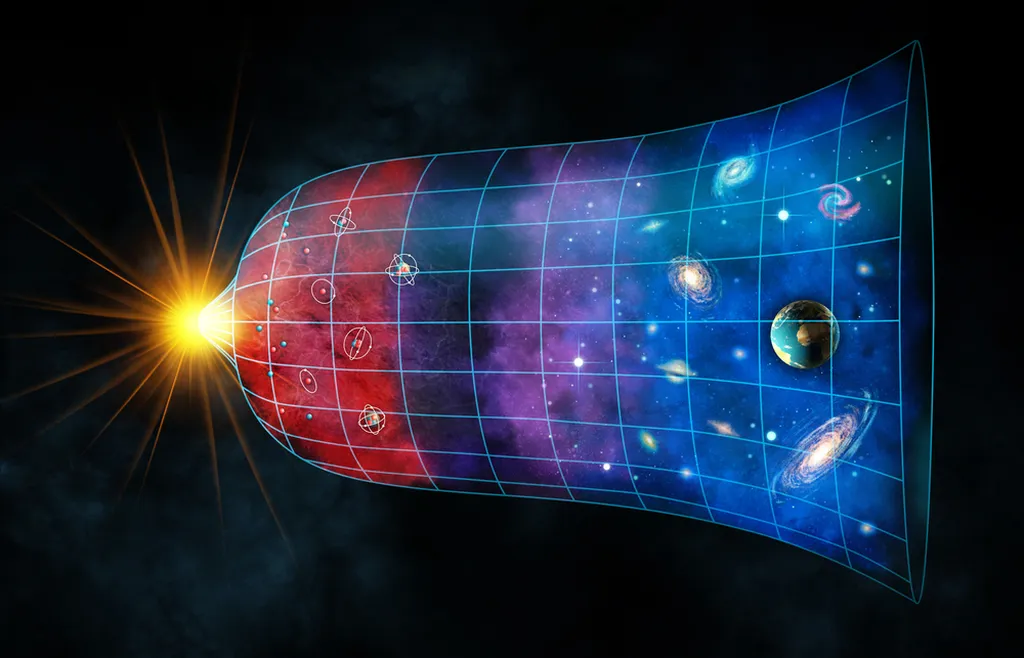
Researchers Enrico Morgante and Riccardo Natale, affiliated with the University of Cambridge, have published a novel study on axion particles and their potential role in dark matter. Their work, titled “A post-inflationary kinetic axion,” explores a unique mechanism for axion production during a specific period of the early universe’s evolution.
In their research, Morgante and Natale propose a scenario where a phase transition, induced by the expansion rate of the universe (Hubble parameter), occurs during a post-inflationary era characterized by a stiff equation of state, known as kination. During this period, a complex field (Φ) experiences a tachyonic instability due to a negative Ricci scalar, which flips the sign of a non-minimally coupled mass term. This instability drives the radial mode of the field to large amplitudes.
As the field amplitude grows, higher-dimensional operators that break a U(1) symmetry become relevant. These operators impart a “kick” in the angular direction, generating a conserved U(1) charge that sustains rotation. Due to the randomization of phases across causally disconnected regions, multiple domains with distinct charges form. The subsequent axion potential then converts these domain charges into an axion abundance, even when the net global charge vanishes.
The researchers analyze the dynamics of this process through a linear, domain-averaged treatment and identify two possible thermal histories. The first involves Ricci reheating via saxion (the scalar component of the complex field Φ) decays to Higgs bosons. The second scenario considers external reheating with efficient damping of saxion energy by Higgs and fermion scatterings.
This mechanism populates regions of parameter space that are underabundant in standard misalignment production, making them accessible to next-generation axion searches. The study was published in the journal Physical Review D.
The practical implications for the energy sector, particularly in relation to dark matter research, could be significant. Understanding the nature of dark matter and its interactions with ordinary matter is crucial for developing new technologies and strategies for energy production, storage, and transmission. While this research is primarily theoretical, it contributes to the broader scientific effort to unravel the mysteries of dark matter, which could ultimately lead to innovative energy solutions.
The research was published in Physical Review D.
This article is based on research available at arXiv.