
In the realm of energy research, a team of scientists from the Swiss Federal Institute of Technology in Lausanne (EPFL) and the University of Applied Sciences and Arts of Southern Switzerland (SUPSI) has developed a novel method to enhance the participation of decentralized flexible resources in European electricity auctions. The researchers, Gabriel Ellemund, Thomas Hübner, Quentin Lété, Stefano Bracco, Matteo Fresia, and Gabriela Hug, have proposed a computationally efficient and highly accurate approach to aggregate flexibility from small-scale resources, such as electric vehicles and heat pumps, to better align their consumption with the intermittent generation of renewable energy.
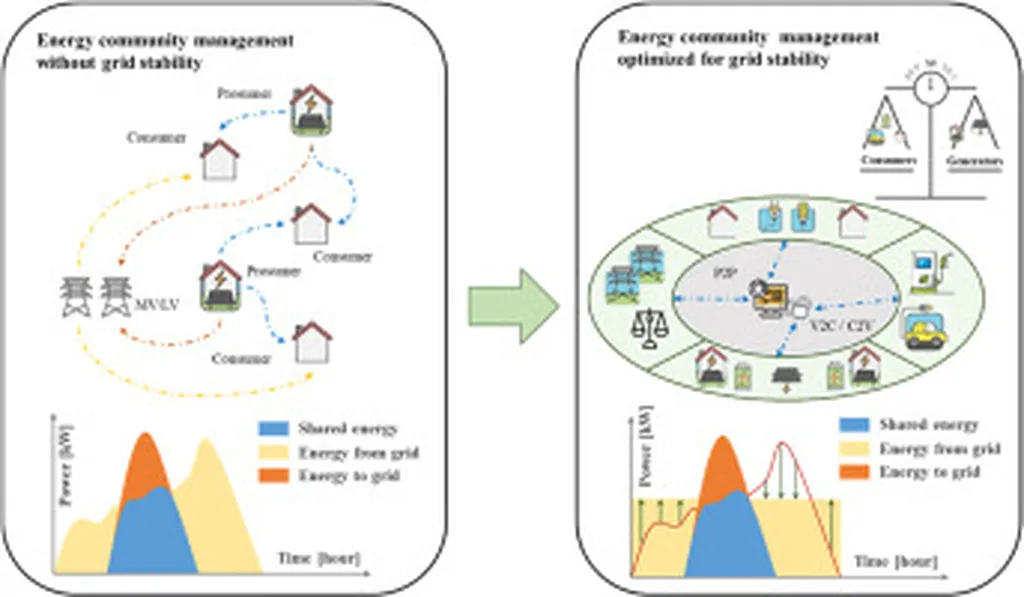
The team’s research focuses on the challenge of integrating decentralized flexible resources into day-ahead and intraday auctions. These resources, while individually too small to participate directly, can collectively make a significant impact on grid stability and renewable energy integration. The key innovation lies in the aggregation process, which identifies economically relevant power profiles through price forecasts and conveys the resulting flexibility to the market operator via exclusive groups of block bids.
The researchers evaluated their method using a case study of a utility serving the Swiss town of Losone. In this scenario, flexibility from multiple heat pumps distributed across the grid was aggregated and bid in the Swiss day-ahead auction. The results were promising, with the method achieving 98% of the theoretically possible cost savings. Notably, the aggregation accuracy remained stable even as the number of heat pumps increased, and the computation time grew only linearly, demonstrating strong scalability.
The practical applications for the energy sector are significant. By enabling more efficient participation of decentralized flexible resources in electricity auctions, this method can enhance grid stability, facilitate the integration of renewable energy, and potentially reduce costs for both consumers and utilities. The research was published in the journal Applied Energy, providing a valuable contribution to the ongoing efforts to modernize and optimize energy systems.
This article is based on research available at arXiv.