
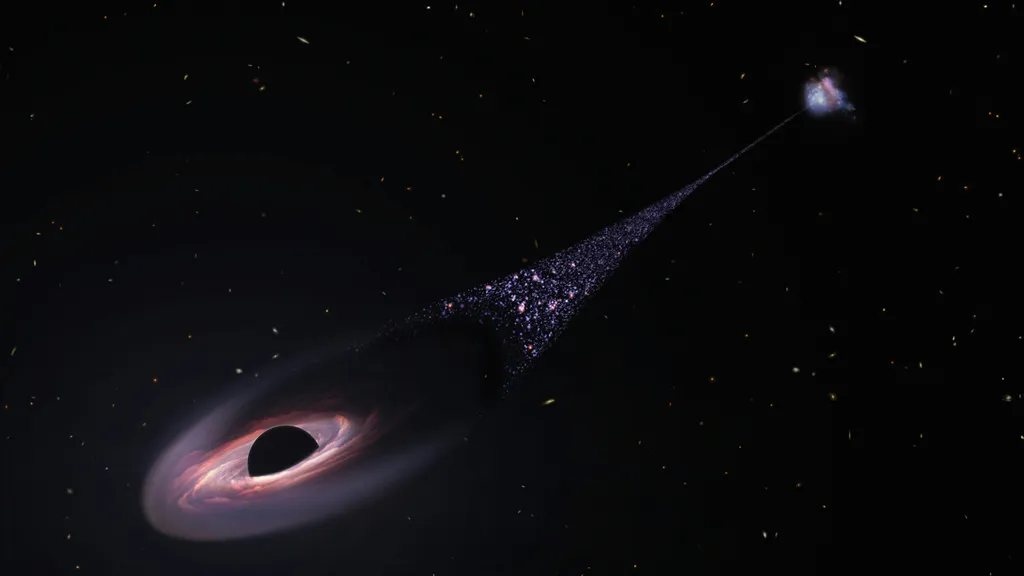
In the realm of energy journalism, it’s not often that we delve into the cosmos, but a recent study has implications that could resonate with the energy sector’s ongoing quest for innovative solutions. The research, led by K. Decker French, Brenna Mockler, Nicholas Earl, and Tanner Murphey from the University of Illinois at Urbana-Champaign, explores the potential of the Vera C. Rubin Observatory to measure black hole masses using Tidal Disruption Events (TDEs).
TDEs occur when a star passes too close to a supermassive black hole and is torn apart by the black hole’s gravitational forces. The Vera C. Rubin Observatory, with its ambitious Legacy Survey of Space and Time, is expected to discover thousands of these events each year. The researchers aimed to model the impact of the Rubin survey strategy on simulated TDE light curves to quantify the typical errors in the recovered parameters, such as black hole mass and the mass of the disrupted star.
The study found that black hole masses ranging from 10^5.5 to 10^8.2 solar masses can be recovered with typical errors of 0.26 dex. Early coverage of these events is crucial as it helps to remove large outliers. However, the recovery of the mass of the disrupted star is more challenging due to the degeneracy with the accretion efficiency. The researchers caution that only 57% of cases accurately determine whether the events are full or partial disruptions, advising against relying on this method to assess the nature of TDEs.
The black hole mass measurements obtained from Rubin observations of TDEs could provide valuable constraints on the black hole mass function, black hole-galaxy co-evolution, and the population of black hole spins. However, the researchers emphasize the need for continued work to understand the origin of TDE observables and how the TDE rate varies among galaxies to fully utilize the upcoming rich data set from Rubin.
While this research may seem far removed from the energy sector, the development of advanced observational techniques and data analysis methods can often find unexpected applications. For instance, the algorithms and strategies developed to analyze TDE data could potentially be adapted to monitor and manage energy infrastructure, or to analyze complex data sets in energy research. Moreover, the study of black holes and their behavior can inspire innovative approaches to energy generation and management, as seen in the concept of black hole power plants, which, while currently theoretical, demonstrates the potential for cross-disciplinary inspiration.
This research was published in the Astrophysical Journal.
This article is based on research available at arXiv.