
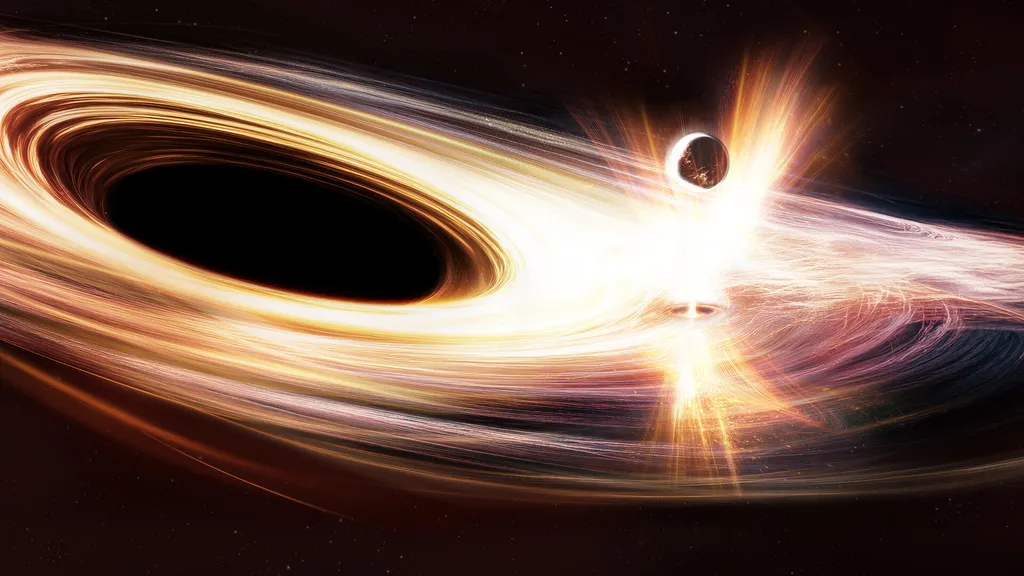
In the realm of energy journalism, it’s crucial to stay abreast of scientific research that could potentially impact the energy sector. A recent study, led by Xiaoshan Huang and colleagues from the University of Arizona, delves into the fascinating phenomenon of tidal disruption events (TDEs), where a black hole disrupts a passing star, creating a burst of energy. The research, published in the Monthly Notices of the Royal Astronomical Society, offers insights that could have implications for understanding energy generation and variability in extreme astrophysical environments.
The team of researchers, including Maria Renee Meza, Sol Bin Yun, Brenna Mockler, Shane W. Davis, and Yan-fei Jiang, utilized advanced three-dimensional, radiation hydrodynamic simulations to model the formation of an accretion disk following the debris stream self-intersection in a TDE. Their findings reveal that a more circularized disk forms about 24 days after the initial stream-stream collision, once the mass fallback rate peaks and the debris stream density decreases.
At early times, the absence of a circularized disk does not hinder the production of a wide range of optical-to-X-ray ratios and soft-X-ray variability. This variability is driven by various shocks and an asymmetric photosphere. The study also found that with strong apsidal precession, the first light emitted is from the stream-stream collision, which launches an optically-thick outflow but produces only modest prompt emission. The subsequent rise in optical and ultraviolet (UV) light is primarily powered by shocks in the turbulent accretion flow near the black hole.
The optical-UV luminosity peaks roughly when the disk forms and shock-driven outflows subside. The disk itself is optically and geometrically thick, extending well beyond the circularization radius. Radiation pressure clears the polar region, leaving optically-thin channels. The researchers obtained the broad-band spectral energy distribution (SED) directly from multi-group simulations with 16-20 frequency groups. The SED features a black body component that peaks in the extreme UV and a soft X-ray component that can be described by a power law associated with bulk Compton scattering.
The blackbody parameters are broadly consistent with observed optical TDEs and vary weakly with viewing angle. In contrast, soft X-ray emission is highly angle-dependent. This research provides a deeper understanding of the complex processes involved in TDEs, which could have practical applications in the energy sector, particularly in the study of extreme energy generation and variability. The insights gained from this study could potentially inform the development of new technologies and strategies for harnessing energy in more conventional settings.
This article is based on research available at arXiv.