
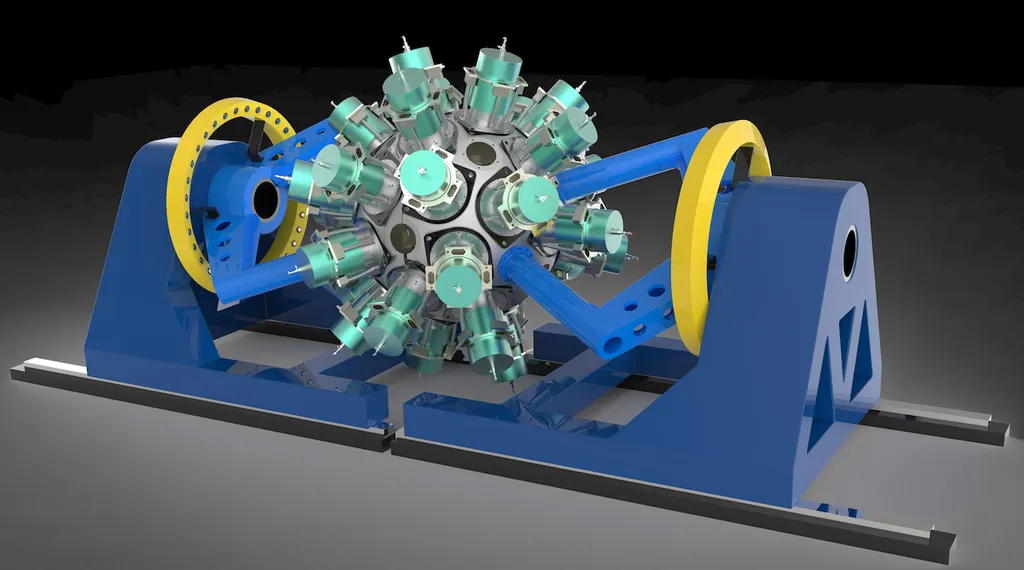
In the realm of nuclear structure and astrophysics research, a team of scientists from the Lawrence Berkeley National Laboratory has been working on enhancing the capabilities of the Gamma-Ray Energy Tracking Array (GRETA), a cutting-edge gamma-ray spectrometer. The researchers involved in this study are Arin Manohar, Mario Cromaz, Christopher Campbell, Heather Crawford, and Marco Salathe.
The team has been focusing on improving the simulation of GRETA’s detector response, which is crucial for accurate gamma-ray tracking. This process involves precisely localizing gamma-ray interactions within the detector’s active volume and tracking the sequences of gamma-ray scattering. To achieve this, the researchers have updated the approach to parameterize the electronics response and explored the impact of detector temperature on signal generation.
The study found that the electronics response can be simplified without compromising performance. Moreover, the response correction parameters can effectively compensate for signal changes due to variations in crystal temperature. This means that the position resolution of GRETA is minimally sensitive to the assumed temperature, a significant improvement for the detector’s accuracy.
The practical applications of this research for the energy sector are notable. Improved gamma-ray spectroscopy can enhance nuclear fuel cycle monitoring, nuclear waste management, and nuclear non-proliferation efforts. By providing more accurate data on nuclear processes, GRETA can support better decision-making in energy production and safety. The research was published in the journal Nuclear Instruments and Methods in Physics Research Section A: Accelerators, Spectrometers, Detectors and Associated Equipment.
This article is based on research available at arXiv.