
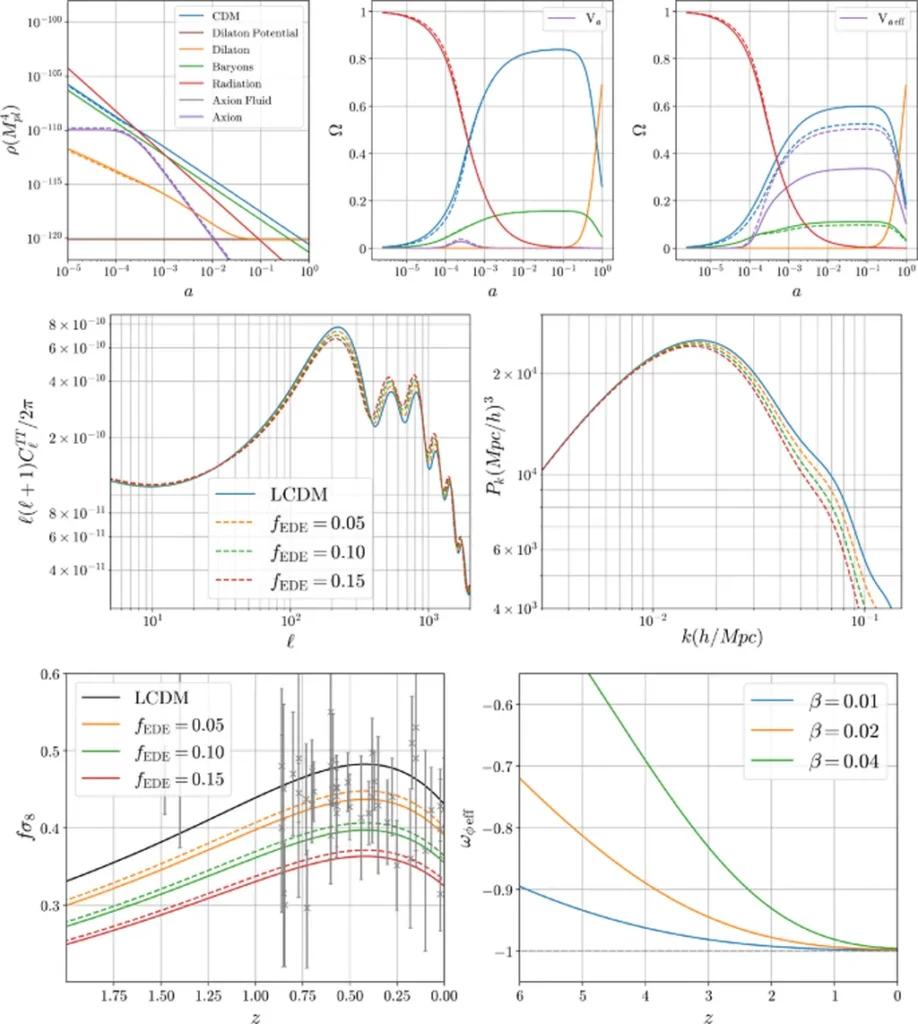
In the realm of cosmology and particle physics, a team of researchers from the University of Sussex, including Adam Smith, Maria Mylova, Carsten van de Bruck, C. P. Burgess, and Eleonora Di Valentino, has been exploring the intriguing possibilities of axio-dilaton cosmology. This model, which ties together dark matter, dark energy, and the evolving masses of particles, has recently been put to the test against a comprehensive set of cosmological observations.
The researchers have investigated a model where the axion, a hypothetical particle, constitutes all of the dark matter, and the dilaton, another hypothetical particle, acts as a dark energy field. This model is well-motivated by fundamental physics and offers a unique perspective on the evolution of the universe. The team confronted this model with data from the Planck 2018 satellite, the SPT-3G high-ℓ measurements, the DESI DR2 BAO, and the Pantheon+ supernovae, among others.
The results of this analysis are promising. The axio-dilaton model fits the data somewhat better than the standard ΛCDM model, with a reduction in χ² by approximately 7 for three additional parameters. Moreover, it significantly raises the inferred Hubble constant to around 69.2 km s⁻¹ Mpc⁻¹, reducing the Hubble tension to less than 3σ. This allows for a joint fit of cosmic microwave background (CMB) data and direct measurements of the Hubble constant, such as those from the SH0ES project.
The model also fits an enlarged data set as well as the w₀wa model with an electron mass modified at recombination, but does so with calculable dynamics. The axio-dilaton self-interactions robustly mimic a phantom equation of state in DESI measurements. However, there is a caveat: cosmology prefers dilaton-matter couplings of around 10⁻² to 10⁻¹, which are large enough to have been detected in solar-system tests of General Relativity.
This research, published in the journal Physical Review Letters, highlights the potential of axio-dilaton cosmology to provide a viable framework for understanding the universe. It suggests new observable signals and theoretical directions, aimed at resolving the apparent inconsistency with non-cosmological observations. While the energy industry may not directly benefit from this research, it contributes to our fundamental understanding of the universe, which can indirectly influence energy-related technologies and policies. For instance, a deeper understanding of dark energy and dark matter could potentially lead to new insights into the long-term evolution of the universe and the ultimate fate of energy sources.
This article is based on research available at arXiv.