
In the realm of high-energy physics, a team of researchers from the University of Santiago de Compostela in Spain—Néstor Armesto, Miguel Ángel Escobedo, Elena G. Ferreiro, and Víctor López-Pardo—have been delving into the mysteries of an exotic meson known as X(3872). Their work, recently published in the journal Physical Review Letters, explores the production of this enigmatic particle in heavy-ion collisions, offering insights that could have implications for our understanding of the strong force and the behavior of matter under extreme conditions.
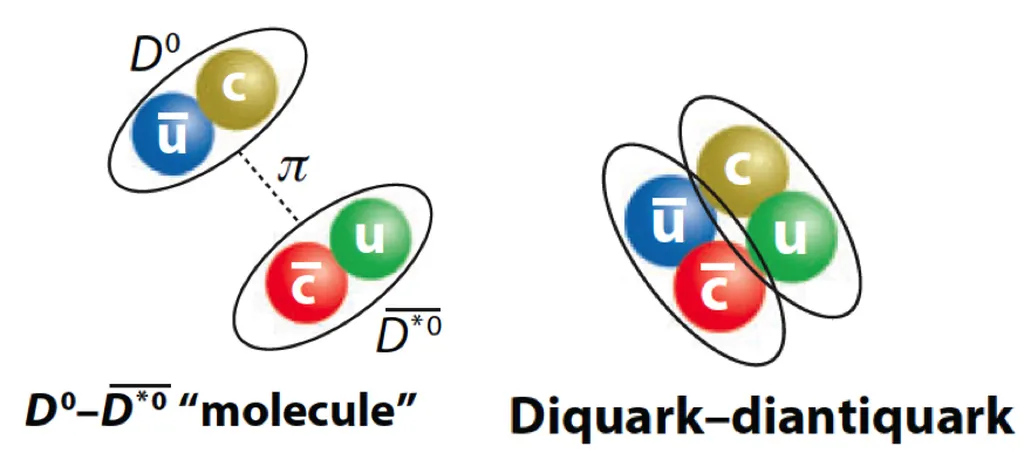
The X(3872) meson is a particle that does not fit neatly into the conventional quark model, which classifies mesons as pairs of quarks. Instead, the X(3872) is believed to be a tetraquark, a more complex structure composed of four quarks. The internal structure of the X(3872) remains an open question, and the researchers set out to investigate its production under the hypothesis that it is indeed a compact tetraquark.
To do this, they derived a coalescence model from the Lindblad equation, a mathematical tool used to describe the evolution of open quantum systems. The model assumes that unbound heavy quarks are thermalized within the quark-gluon plasma—a state of matter thought to have existed just after the Big Bang—and that the adiabatic approximation holds, meaning that the system changes slowly enough to remain in equilibrium.
Using this model, the researchers predicted the nuclear modification factor of the X(3872) at Large Hadron Collider (LHC) energies. The nuclear modification factor is a measure of how the production of a particle in heavy-ion collisions differs from that in proton-proton collisions. The proton-proton baseline cross sections were estimated from available experimental data. The results indicated that recombination—the process by which unbound quarks combine to form the X(3872)—is the dominant production mechanism for a tetraquark X(3872). This leads to a significant yield enhancement in heavy-ion collisions, suggesting that the nuclear modification factor is a powerful observable for probing the exotic nature of this state.
The researchers also considered the effect of simplifying assumptions on the model and explored a complementary approach based on chemical equilibration. Their findings contribute to our understanding of the production mechanisms of exotic hadrons in heavy-ion collisions, which could have practical applications in the energy sector, particularly in the development of advanced materials and technologies that can withstand extreme conditions.
In summary, the work of Armesto, Escobedo, Ferreiro, and López-Pardo sheds light on the production of the X(3872) meson in heavy-ion collisions, offering valuable insights into the behavior of matter under extreme conditions and the potential applications of this knowledge in the energy sector. Their research was published in Physical Review Letters, a prestigious journal in the field of physics.
This article is based on research available at arXiv.