
In the realm of astrophysics and energy research, a team of scientists from the University of Tokyo, including Kengo Shinoda, Yudai Suwa, Ryosuke Hirai, Ryo Sawada, Kengo Tomida, Kazunari Iwasaki, and Takeru K. Suzuki, has delved into the intricate dynamics of core-collapse supernovae. Their work, published in the esteemed journal Monthly Notices of the Royal Astronomical Society, sheds light on the impact of hydrogen envelopes on the fallback of supernova material and the resulting masses of compact remnants.
Core-collapse supernovae are monumental explosions that mark the end of a massive star’s life. These events are pivotal in the universe’s energy dynamics and the creation of compact objects like neutron stars and black holes. The researchers focused on how the presence of a hydrogen envelope in these stars influences the fallback process, where material initially ejected during the supernova explosion falls back onto the central remnant.
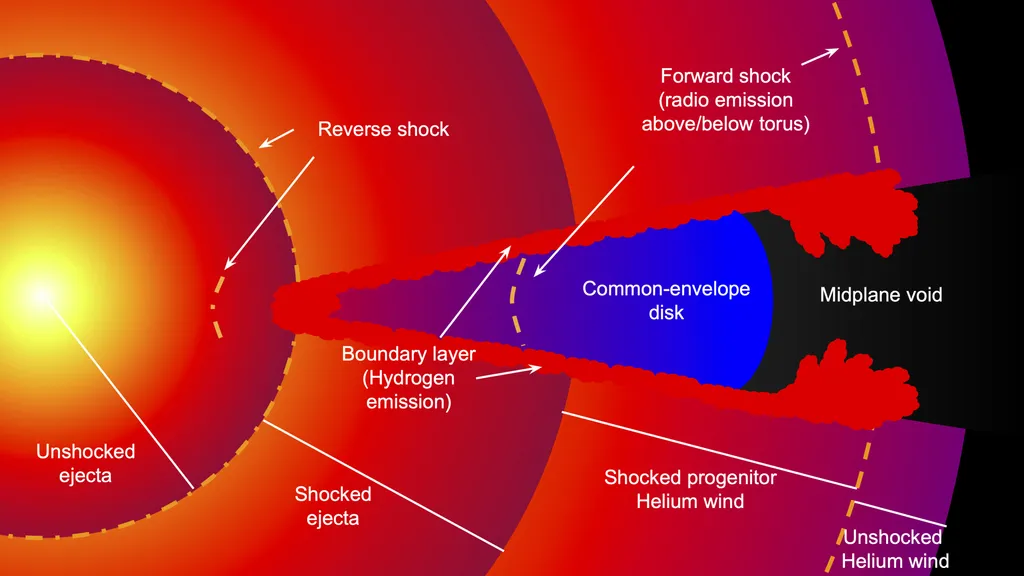
The team conducted one-dimensional hydrodynamic simulations of metal-poor progenitors with initial masses ranging from 18 to 28 times the mass of the Sun. They explored a wide range of explosion energies, from 10^48 to 10^52 ergs, in models both with and without hydrogen envelopes. Their findings revealed a consistent pattern: when the explosion energy is just 2 to 3 times the binding energy of the hydrogen envelope, a reverse shock forms at the hydrogen-helium interface. This reverse shock travels back to the center of the explosion, significantly increasing the mass of the compact remnant by more than 2 solar masses.
Beyond this energy threshold, the reverse shock escapes, and the remnant masses of hydrogen-rich progenitors become nearly identical to those of stripped-envelope progenitors. By normalizing their results with the envelope binding energy, the researchers demonstrated that all progenitor models converge to a common fallback relation. This relation provides a crucial link between the properties of the progenitor star and the final mass of the compact remnant.
The practical implications of this research for the energy sector are profound. Understanding the dynamics of supernova explosions and the formation of compact remnants is essential for modeling galactic chemical evolution and population synthesis. These models are integral to predicting the distribution of stellar remnants, which in turn influences the energy dynamics of galaxies. Additionally, the insights gained from this study can enhance our understanding of the progenitors of gravitational wave sources, which are of significant interest in the field of astrophysics and energy research.
In summary, the work of Shinoda and his colleagues provides a robust framework for connecting progenitor properties to compact-remnant masses. Their findings offer a valuable tool for researchers studying the energy dynamics of the universe and the evolution of stellar remnants. This research not only advances our theoretical understanding but also has practical applications in the energy sector, particularly in the modeling of galactic chemical evolution and the study of gravitational wave sources.
This article is based on research available at arXiv.