
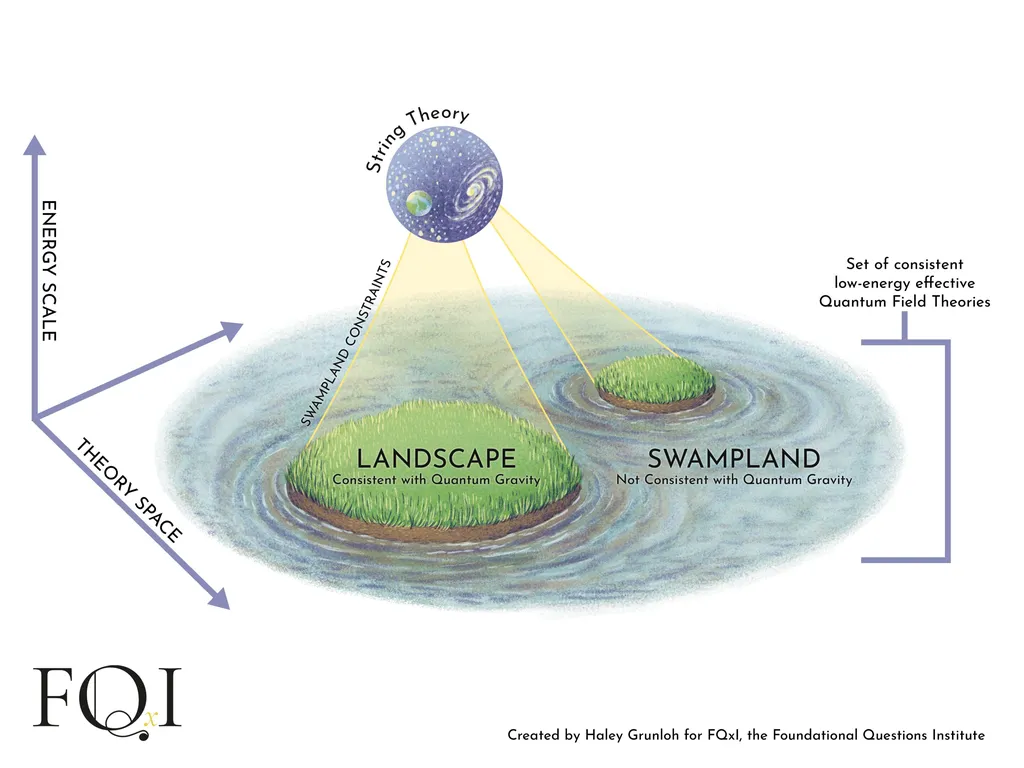
Sirui Ning, a researcher at the University of Amsterdam’s Institute for Theoretical Physics, has delved into the intricacies of string theory and its implications for energy and information dynamics in theoretical physics. The research, published in the journal Physical Review D, explores the complex landscape of four-dimensional vacua within string theory, utilizing the AdS/CFT correspondence to gain insights into these high-dimensional spaces.
Ning’s work is divided into two main parts. In the first part, the researcher investigates fibred Calabi-Yau manifolds and M-theory moduli stabilization scenarios. The study considers both flux-stabilized models and non-perturbative stabilization methods. By performing a holographic analysis, Ning aims to understand the spectrum of the assumed dual conformal field theory (CFT₃) and its implications for the AdS/CFT correspondence. The findings suggest that for flux stabilization, which relies on a large complex Chern-Simons invariant, moduli have integer dimensions similar to those observed in the DGKT flux-stabilized model in type IIA string theory. For non-perturbative stabilization, the results align with race-track models in type IIB string theory.
In the latter part of the thesis, Ning tackles the Wheeler-DeWitt equation for a planar Reissner-Nordstrom-AdS black hole within a minisuperspace approximation. The researcher constructs semiclassical Wheeler-DeWitt states from Gaussian wavepackets that are peaked on classical black hole interior solutions. By using the metric component gₓₓ as a clock, these states are evolved through both the exterior and interior horizons. The study reveals that near the singularity, quantum fluctuations in the wavepacket become significant, leading to a breakdown of the classicality of the minisuperspace approximation. Towards the AdS boundary, the Wheeler-DeWitt states are employed to recover the Lorentzian partition function of the dual theory residing on this boundary. This partition function is characterized by an energy and a charge. Furthermore, the research demonstrates that the Wheeler-DeWitt states encapsulate black hole thermodynamics, recovering the grand canonical thermodynamic potential after appropriate averaging at the black hole horizon.
While this research is primarily theoretical and abstract, it contributes to the broader understanding of string theory and holography, which could have indirect implications for the energy sector. For instance, advancements in theoretical physics often pave the way for new technologies and insights into energy dynamics. The study of black hole thermodynamics and the holographic principle could potentially offer novel perspectives on energy storage, transfer, and efficiency in the future. However, these applications remain speculative and are not the immediate focus of the current research.
This article is based on research available at arXiv.