
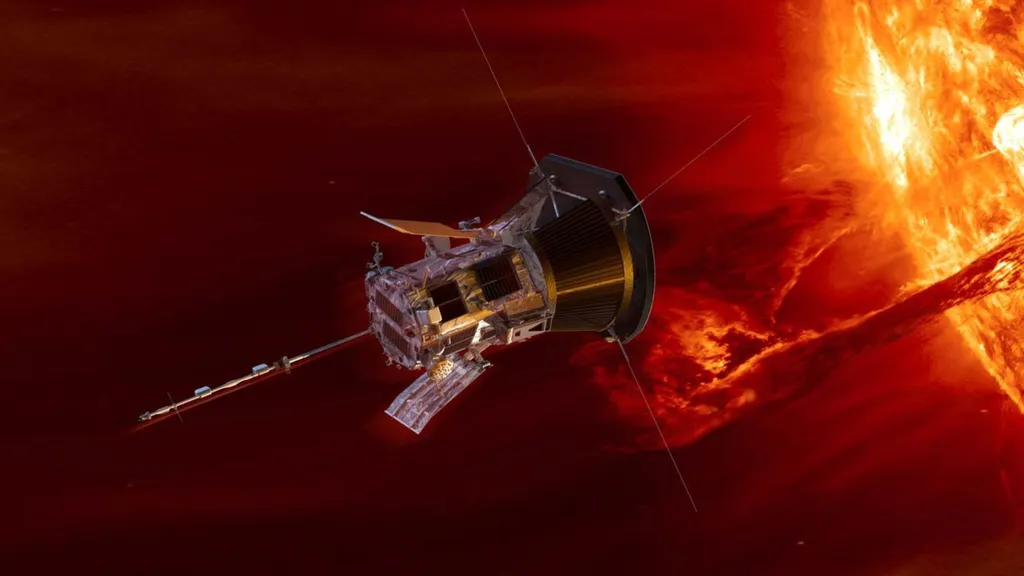
In the realm of solar research, a team of scientists led by Niranjana Shankarappa from the Smithsonian Astrophysical Observatory has been delving into the data collected by NASA’s Parker Solar Probe (PSP). Their findings, published in the Astrophysical Journal, shed light on the behavior of ion-scale waves in the inner heliosphere, which could have implications for our understanding of plasma physics and, potentially, energy generation technologies.
The researchers, including Kristopher G. Klein from the University of Arizona, Mihailo M. Martinović from the University of Alabama in Huntsville, and others, have been analyzing the data from PSP’s encounters with the Sun. They found that the probe frequently observes circularly polarized ion-scale waves, which are a signature of the interaction between plasma microinstabilities and turbulent dissipation.
These waves come in two types: left-handed waves (LHWs) and right-handed waves (RHWs). The team discovered that LHWs are more common, with their occurrence increasing as the probe gets closer to the Sun, reaching about 30%. These waves are generally consistent with parallel propagating ion cyclotron wave (ICW) storms that last for extended periods. Interestingly, the turbulent energy spectra are consistently steeper when these LHW storms are observed, indicating that these waves help mediate the spatial transport of the free energy associated with temperature anisotropy.
On the other hand, RHWs are less frequently observed, with their occurrence decreasing as the probe approaches the Sun. These waves are generally consistent with oblique and parallel fast magnetosonic waves (FMWs). The observation of RHWs is well correlated with enhanced proton parallel heat flux, which quantifies the presence of secondary proton populations. Using observations and the SAVIC machine learning instability identification algorithm, the researchers identified a threshold on the proton heat flux beyond which FMWs are likely to be driven unstable by the proton beams.
The practical applications of this research for the energy sector are not immediately clear, as the study is primarily focused on fundamental plasma physics. However, understanding the behavior of these waves could potentially contribute to the development of more efficient and stable plasma-based energy generation technologies, such as fusion reactors. The insights gained from this research could also help improve our understanding of space weather, which can have significant impacts on satellites and other space-based technologies that are crucial for energy infrastructure.
In conclusion, the research led by Shankarappa and her team provides valuable insights into the behavior of ion-scale waves in the inner heliosphere. While the direct applications to the energy sector may be indirect, the fundamental understanding gained from this research could pave the way for advancements in plasma-based energy technologies and space weather prediction.
This article is based on research available at arXiv.