
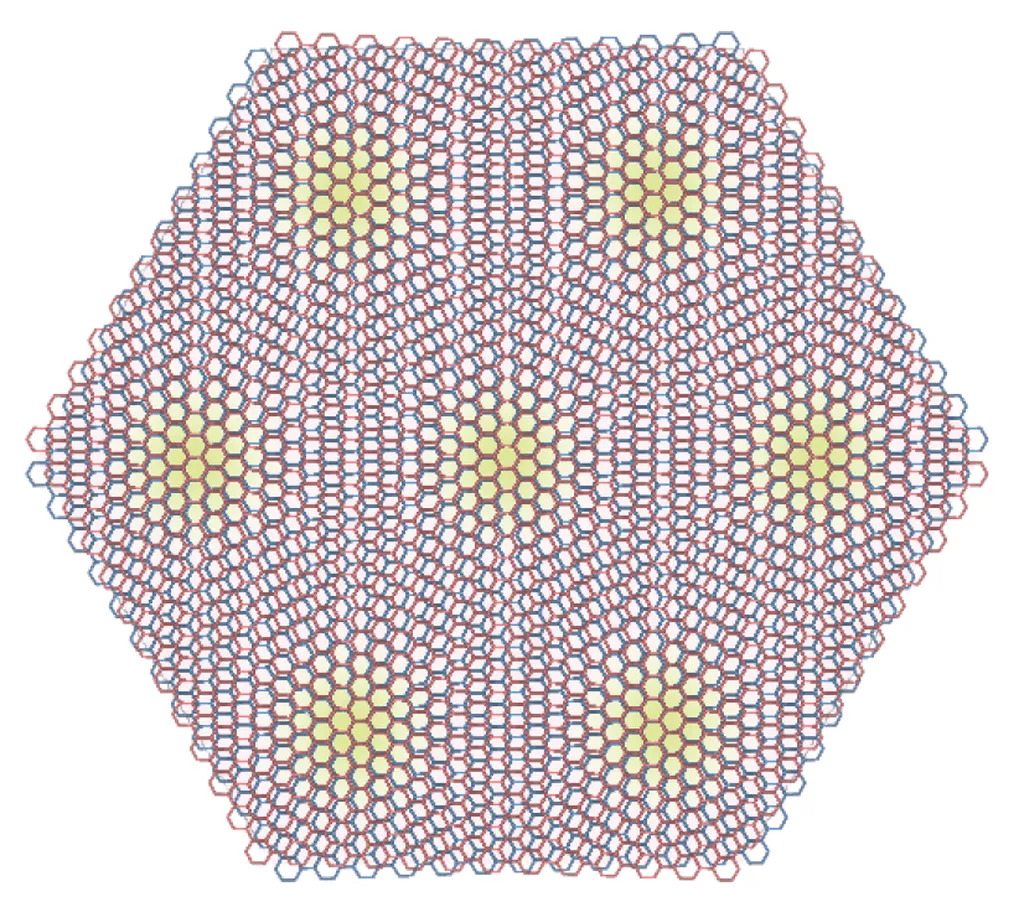
Researchers Nadina Gheorghiu, Charles R. Ebbing, George Y. Panasyuk, and Timothy J. Haugan have recently published a study exploring the intriguing properties of hydrogenated graphitic fibers and multi-layer graphene. Their work, titled “Fibonacci sequence of twist angles in superconducting multi-layer graphene and hydrogenated graphitic fibers,” delves into the unique electronic behaviors that emerge from specific twist angles between graphite layers. This research was published in the journal [Nature Communications].
The study focuses on the twist angles between adjacent layers in graphite, which can occur naturally or be artificially induced. These angles influence the way charge and spin are transported through the material. In two-dimensional systems, certain twist angles create a saddle point in the electronic band structure, leading to a phenomenon known as van Hove singularities (vHs). These singularities are points where the density of electronic states becomes very high, significantly affecting the material’s properties.
The researchers found that the energy difference between the vHs for the conduction and valence bands increases with the twist angle between neighboring graphite domains. Interestingly, they discovered that these energy differences might follow the Fibonacci sequence, a series of numbers where each number is the sum of the two preceding ones. This mathematical pattern has been observed in various natural phenomena, and its appearance in this context suggests a deep underlying order in the electronic properties of these materials.
Furthermore, the study suggests that superconducting hydrogenated graphite can exhibit higher-order topology, which is reflected in a flattening of the energy gap. This flattening can have significant implications for the material’s electronic behavior and potential applications. The researchers conducted charge transport and magnetization measurements using a Quantum Design Physical Properties Measurement System to support their findings.
The practical applications of this research for the energy sector are promising. Understanding and controlling the electronic properties of graphitic materials through twist angles could lead to the development of more efficient and novel energy storage solutions, such as advanced batteries or superconductors. Additionally, the insights gained from this study could contribute to the design of new materials for energy conversion and transmission, potentially revolutionizing the way we harness and utilize energy.
This article is based on research available at arXiv.