
In the realm of astrophysics and energy research, a team of scientists from various institutions, including Paola Martire and Elena Maria Rossi from the University of Amsterdam, Nicholas Chamberlain Stone from Columbia University, Elad Steinberg from the Hebrew University of Jerusalem, and Konstantinos Kilmetis and Itai Linial from the Weizmann Institute of Science, have conducted a groundbreaking study on tidal disruption events (TDEs). Their research, published in the journal Nature Astronomy, sheds light on the mechanisms behind the luminosity peaks observed in these cosmic phenomena.
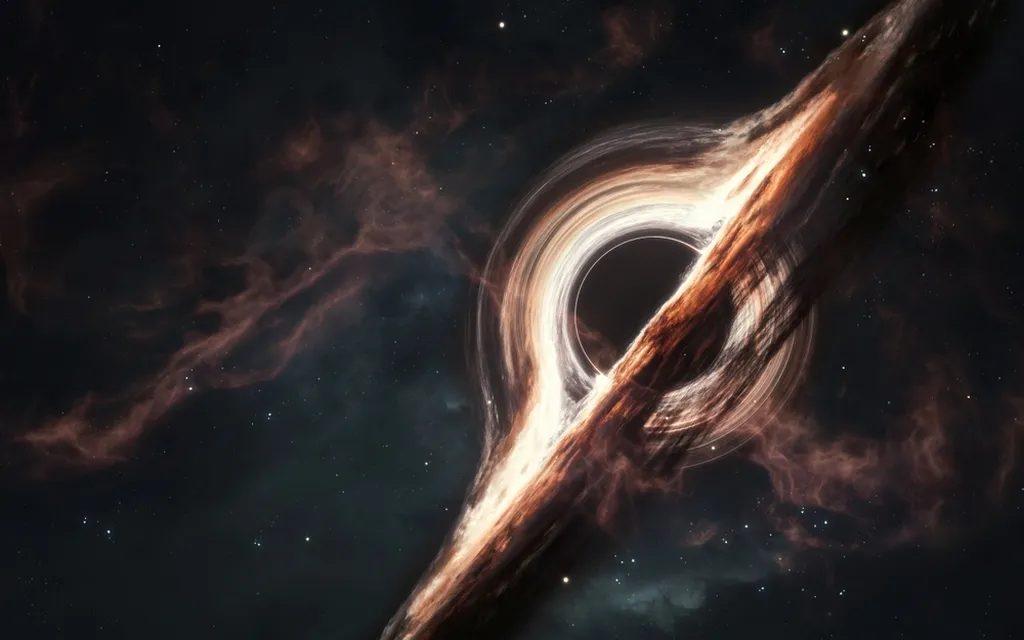
Tidal disruption events occur when a star wanders too close to a black hole and is torn apart by the immense gravitational forces. The resulting debris forms a bright flare, which can provide valuable insights into the behavior of black holes and the physics of accretion. However, the exact processes driving the luminosity peaks in these events have remained elusive. The team’s study aims to address this gap in our understanding by simulating a TDE involving an intermediate-mass black hole (IMBH) with a mass of 10,000 times that of the Sun.
The researchers employed a sophisticated radiation-hydrodynamics code called RICH to create the first three-dimensional, end-to-end simulation of a TDE with realistic parameters. Their simulation revealed that the stellar debris does not circularize efficiently, as previously thought. Instead, a low-density, radiation-driven wind forms near the point of closest approach (pericenter) and expands quasi-spherically. This wind carries radiation away from the black hole, releasing it at the photosphere—the outer shell of the star where light escapes. The photosphere expands to radii of approximately 10^13 centimeters and reaches temperatures of a few tens of thousands of Kelvin at the peak of the light curve.
The luminosity generated by this process briefly exceeds the Eddington limit—a theoretical maximum luminosity for a given mass—before settling near that value. The Eddington limit is a critical concept in astrophysics, as it represents the balance between the outward radiation pressure and the inward gravitational force. Understanding how this limit is reached and maintained in TDEs can provide valuable insights into the energy dissipation processes in these events.
The researchers also tested the numerical convergence of their simulation by running it at three different resolutions. While the shock at pericenter may be under-resolved, the global results of the simulation are qualitatively converged and largely quantitatively robust. This ensures the reliability of their findings and the conclusions drawn from the simulation.
The study also highlights the potential for upcoming astronomical surveys, such as the Vera Rubin Observatory’s Legacy Survey of Space and Time (LSST) and the Ultraviolet Transient Astronomy Satellite (ULTRASAT), to observe events like the simulated IMBH TDE up to redshifts of approximately 0.1 and 0.06, respectively. These observations will be crucial for validating the simulation results and furthering our understanding of TDEs.
In the context of the energy industry, the insights gained from this research can contribute to the development of more accurate models for energy dissipation and radiation transport in extreme astrophysical environments. These models can, in turn, inform the design and optimization of energy systems that rely on similar principles, such as nuclear fusion reactors. Additionally, the study’s findings can enhance our understanding of the fundamental processes governing black hole accretion and the release of energy in the universe, which can have broader implications for energy research and technology development.
As we continue to explore the cosmos and unravel the mysteries of black holes and TDEs, the work of Martire, Rossi, Stone, Steinberg, Kilmetis, and Linial serves as a testament to the power of advanced simulations and the potential for interdisciplinary research to drive innovation in the energy sector. Their study not only advances our knowledge of astrophysical phenomena but also paves the way for new applications and technologies that can harness the energy of the universe in more efficient and sustainable ways.
This article is based on research available at arXiv.