
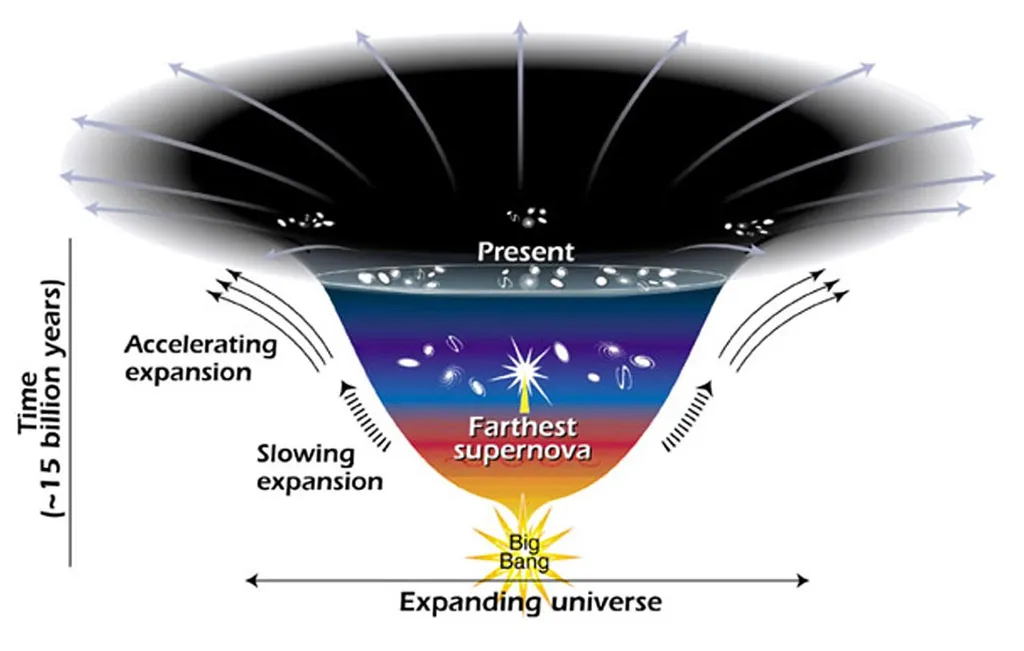
Christopher Cook and Joel Meyers, researchers from the University of Texas at Austin, have delved into the early universe to explore the potential of Big Bang Nucleosynthesis (BBN) as a tool for understanding dark energy and other fundamental physics. Their work, published in the journal Physical Review D, offers a fresh perspective on how the early expansion of the universe can be studied and what it might reveal about the energy sector’s fundamental underpinnings.
Big Bang Nucleosynthesis is one of the earliest processes in the universe that scientists can directly observe. It’s a process that created the first atomic nuclei, and it’s highly sensitive to the conditions of the early universe, including the rate of expansion. Cook and Meyers leveraged recent advances in theory, observation, and statistical techniques to place constraints on deviations from the standard model of cosmic expansion during BBN.
The researchers used the latest abundance data of light elements like deuterium and helium-4, along with precise measurements of the baryon density from the cosmic microwave background. They applied principal component analysis to identify the most constrained and physically meaningful modes of expansion history variation. This approach allowed them to impose general constraints on early dark energy during the epoch of BBN.
One of the intriguing aspects of their work is the examination of whether general modifications to the expansion rate could help resolve the long-standing lithium problem—a discrepancy between the predicted and observed abundances of lithium in the universe. While their results do not conclusively solve this problem, they demonstrate that BBN, enhanced by modern data and statistical techniques, remains a powerful probe of dark energy and new physics in the early universe.
For the energy sector, understanding the fundamental physics of the early universe can have profound implications. Dark energy, which is thought to be driving the accelerated expansion of the universe, remains one of the most enigmatic components of the cosmos. Insights into its nature and behavior could potentially lead to new energy technologies or a deeper understanding of the forces that govern our universe. While these applications are speculative and far-reaching, the foundational research conducted by Cook and Meyers is a crucial step in advancing our knowledge of the early universe and its implications for energy and beyond.
This article is based on research available at arXiv.