
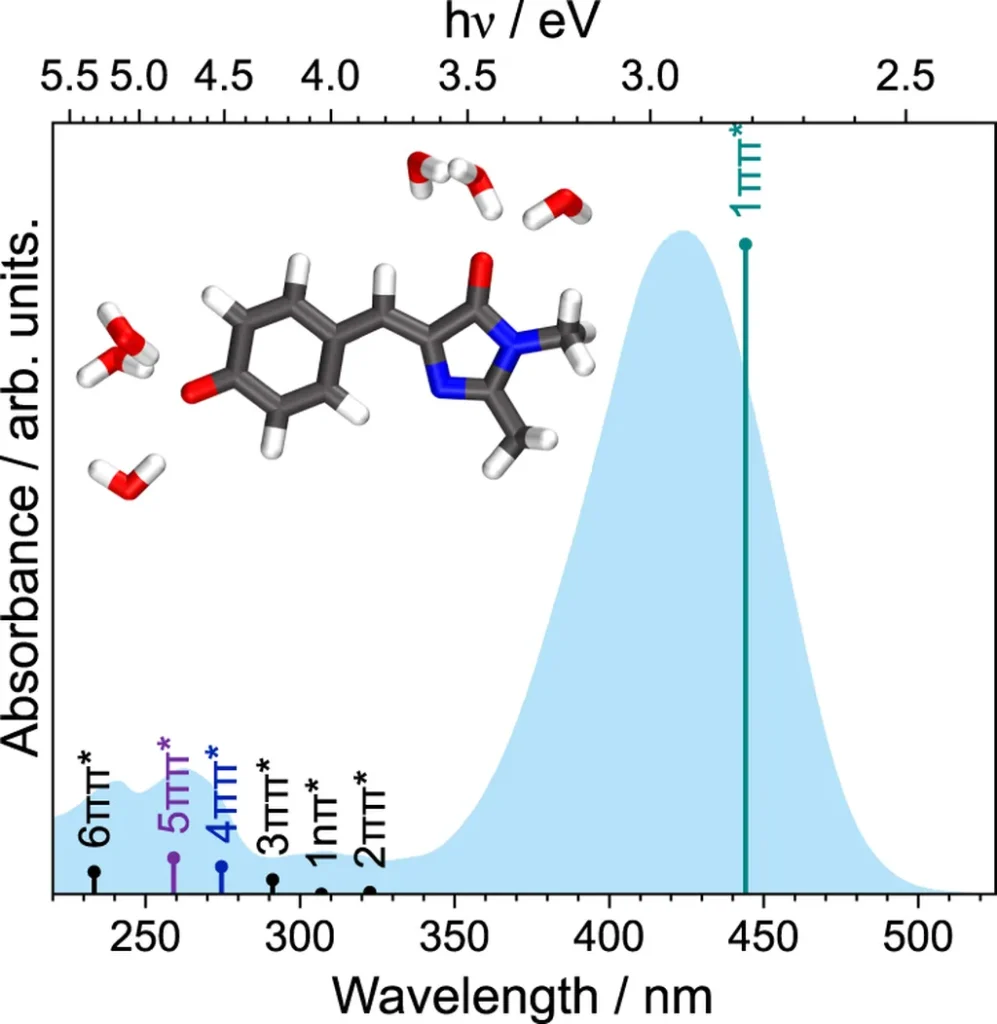
In the realm of energy research, understanding how light interacts with matter is crucial for developing efficient energy technologies. A team of researchers from the University of Durham, University of Copenhagen, and University of Southampton has made significant strides in this area by studying the behavior of a model chromophore from the green fluorescent protein (GFP). Their work, published in the journal Nature Communications, sheds light on the role of “dark states” in photostability and light harvesting, which could have practical applications in the energy sector.
The researchers, led by Elisabeth Gruber and Jan R. R. Verlet, focused on the isolated anion of the GFP chromophore. They employed advanced techniques such as ultrafast time-resolved action-absorption and photoelectron spectroscopy to observe and characterize an optically dark, low-lying singlet excited state. This state, which forms in just 100 femtoseconds (fs), has a remarkably long lifetime of 94 picoseconds (ps). The team also conducted high-level ab initio calculations to understand the precise trapping mechanism and the charge-transfer character of this dark state.
The significance of this research lies in its potential to enhance the efficiency and stability of light-harvesting systems. In the energy industry, technologies such as photovoltaics and artificial photosynthesis rely on the ability to capture and convert light energy efficiently. The discovery of this long-lived dark state in the GFP chromophore provides insights into how nature optimizes light harvesting and photostability. By mimicking these natural mechanisms, researchers can develop more robust and efficient energy conversion systems.
Moreover, the study highlights the importance of understanding dark states, which are often overlooked in favor of more visible, or “bright,” states. The dark states play a crucial role in photoprotection, preventing electron emission and stabilizing electronic excitation even when the energy exceeds the electron detachment threshold. This knowledge can be applied to design materials that are more resistant to photodegradation, a common issue in solar energy technologies.
In summary, the research conducted by Gruber, Verlet, and their colleagues offers valuable insights into the fundamental processes governing light-matter interactions. By uncovering the role of dark states in photostability and light harvesting, this work paves the way for advancements in energy technologies. The practical applications of these findings could lead to more efficient and durable solar cells, artificial photosynthesis systems, and other energy conversion devices, ultimately contributing to a more sustainable energy future.
This article is based on research available at arXiv.