
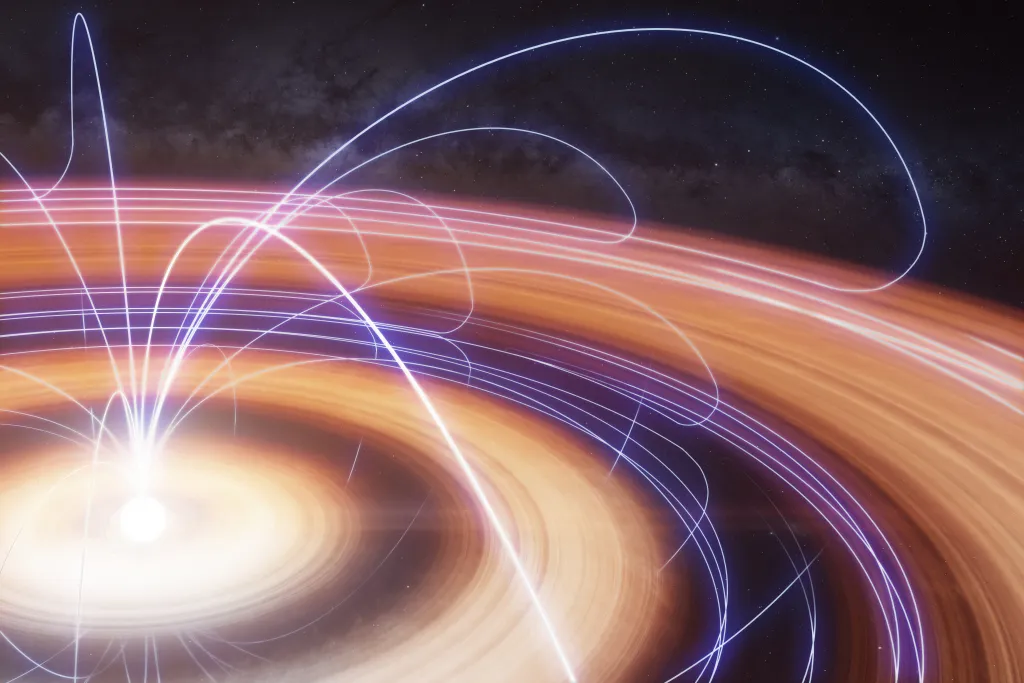
Albert Elias-López, a researcher at the University of Vienna, has been delving into the complex world of astrophysical dynamos and their applications to giant planets. His work, published in the journal “Monthly Notices of the Royal Astronomical Society,” offers valuable insights into the magnetic fields of planets and stars, with potential implications for our understanding of planetary systems and their evolution.
Elias-López’s research focuses on the phenomenon of self-sustaining dynamos, which convert fluid motion into magnetic energy. These dynamos are crucial for explaining the magnetization of planets, stars, and galaxies, as ancient fields alone cannot account for the present magnetic activity observed in these systems. To better understand this process, Elias-López employs numerical magnetohydrodynamic (MHD) simulations, which model the behavior of electrically conducting fluids like plasma.
In one part of his study, Elias-López uses 3D MHD simulations with the Pencil Code to investigate magnetic growth from irrotational, subsonic expansion flows. These flows, which mimic stellar explosions and winds, drive turbulence and seed magnetic amplification in the interstellar medium (ISM). By studying these processes, researchers can gain a better understanding of the magnetic fields that permeate our galaxy and influence its dynamics.
The second part of Elias-López’s research examines planetary dynamos, focusing on the magnetic fields of gas giant planets. He outlines the properties of these magnetic fields and their modeling through convection in spherical shells. Although many exoplanets have been discovered, detecting their magnetic fields remains a challenge. However, Elias-López suggests that these fields may be observable through coherent radio emission with new low-frequency instruments.
Using 3D dynamo simulations with the MagIC code, coupled to thermodynamic profiles from MESA-based evolution models, Elias-López studies the magnetic evolution of cold gas giants. His models reveal a slow decline in field strength, a shift from multipolar to dipolar states, and clear evolutionary trends in dynamo behavior. These findings could help researchers better understand the magnetic fields of giant planets in our solar system and beyond.
Elias-López also investigates hot Jupiters, exoplanets that orbit very close to their host stars and experience strong irradiation. This heating can alter convection and rotation, potentially affecting the planet’s magnetic field. His research suggests that most hot Jupiters remain fast rotators, but massive, distant planets may enter different regimes. When heating is concentrated in outer layers, convection in the dynamo region weakens, reducing expected field strengths and helping explain the absence of confirmed detections in past radio surveys.
The practical applications of this research for the energy sector are not immediately apparent, as the study primarily focuses on astrophysical phenomena. However, a deeper understanding of magnetic fields and dynamos can contribute to various fields, including space weather prediction, which is crucial for protecting satellites and other space-based infrastructure. Additionally, insights into planetary magnetic fields can inform our understanding of planetary formation and evolution, which may have implications for the search for habitable exoplanets and the potential for extraterrestrial life.
In conclusion, Albert Elias-López’s research on astrophysical dynamos and their applications to giant planets offers valuable insights into the magnetic fields that permeate our universe. While the direct implications for the energy sector may be limited, the study’s findings contribute to our broader understanding of planetary systems and their evolution, paving the way for future discoveries and technological advancements.
This article is based on research available at arXiv.