
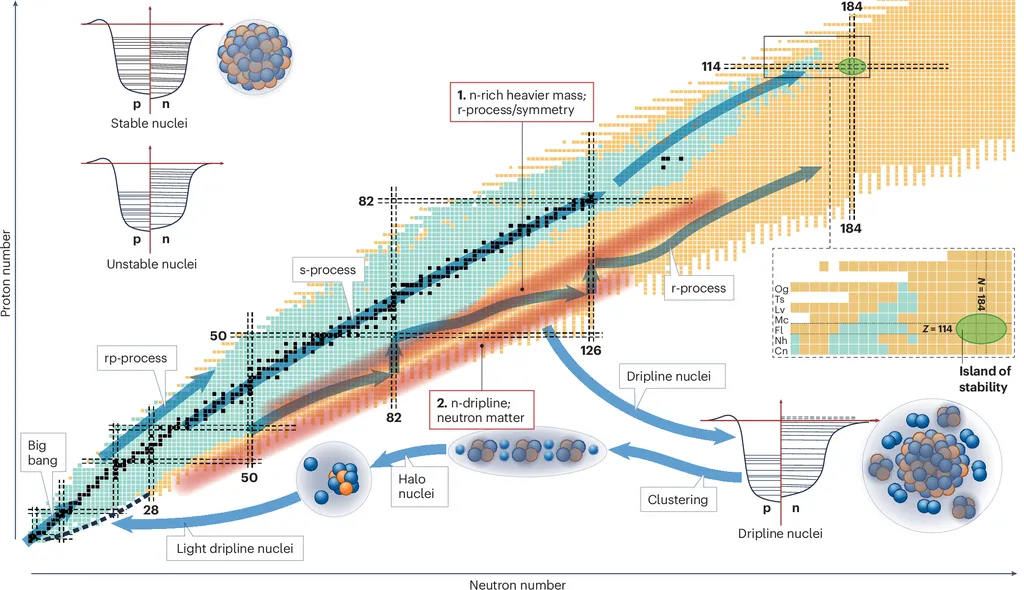
Researchers Daniel Kromm, Matthias Göbel, and Hans-Werner Hammer from the Institute for Nuclear Physics at Technische Universität Darmstadt have published a study in the journal Physical Review C that delves into the intricacies of two-neutron halo nuclei, a type of exotic atomic nucleus. Their work focuses on refining the theoretical framework used to describe these nuclei, with potential implications for understanding certain nuclear processes relevant to energy production and nuclear waste management.
The team’s research centers around an Effective Field Theory (EFT) proposed by Hongo and Son, which is used to describe two-neutron halo nuclei where the interaction between the neutrons and the core of the nucleus is relatively weak. In such nuclei, the ratio of the mean-square matter radius to the charge radius is universal, depending only on the two-neutron separation energy and the neutron-neutron scattering length. The researchers found that to predict both radii separately, an additional renormalization condition is necessary. They developed a renormalization scheme that uses either the mean square radius or the scattering amplitude as input.
Using this refined theory, the researchers calculated the matter radii of several two-neutron halo nuclei, including $^{11}$Li, $^{14}$Be, $^{17}$B, $^{19}$B, and $^{22}$C. They compared their results with those obtained using the standard Halo EFT, using both the physical value of the neutron-core scattering length and rescaled values. They observed good agreement with Hongo and Son’s results when the neutron-core interaction was negligible. Similar agreement was also found for the halo nucleus $^6$He, where the neutron-core interaction is in the p-wave.
The researchers also investigated the divergence structure of the theory and found that the Landau pole, a concept in quantum field theory indicating a breakdown of the theory at high energies, restricts the ultraviolet cutoff to relatively low values for all the considered halo nuclei. They calculated the position of the Landau pole for various halo nuclei, making the restriction in the ultraviolet cutoff explicit.
Furthermore, the team derived an explicit expression for the three-to-three neutron-neutron-core scattering amplitude and discussed its cut structure. This work provides a deeper understanding of the behavior of two-neutron halo nuclei and improves the theoretical tools available for studying these exotic nuclear systems.
The practical applications of this research for the energy sector include a better understanding of nuclear processes involved in advanced nuclear reactors and the transmutation of nuclear waste. By improving the theoretical models of exotic nuclei, researchers can enhance the accuracy of simulations and predictions related to nuclear energy production and waste management.
The research was published in the journal Physical Review C, a publication of the American Physical Society.
This article is based on research available at arXiv.