
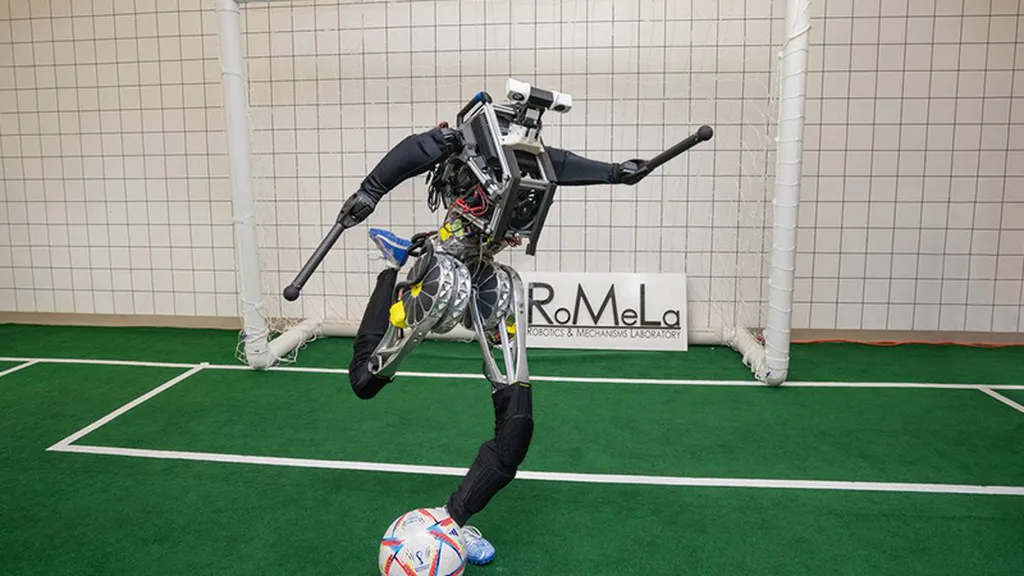
In the realm of robotics and artificial intelligence, a team of researchers from the University of California, Los Angeles (UCLA) has made significant strides in developing advanced humanoid robots. Led by Dennis W. Hong, the team has introduced innovations that could have profound implications for the energy sector, particularly in automation and remote operations.
The researchers presented their findings in a paper titled “A Hierarchical, Model-Based System for High-Performance Humanoid Soccer,” which was published in the prestigious journal Science Robotics. The study details the hardware and software advancements that enabled their team, ARTEMIS, to win the RoboCup 2024 Adult-Sized Humanoid Soccer Competition. This competition serves as a challenging benchmark for autonomous humanoid robots, with the ultimate goal of competing against human soccer players by 2050.
On the hardware front, the team introduced an adult-sized humanoid platform featuring lightweight structural components, high-torque quasi-direct-drive actuators, and a specialized foot design. These innovations allow the robot to perform powerful kicks while maintaining locomotion robustness. The lightweight and efficient design principles could be applied to robotic systems used in the energy sector, such as inspection and maintenance robots in hazardous environments, where energy efficiency and maneuverability are crucial.
The software innovations are equally impressive. The team developed an integrated perception and localization framework that combines stereo vision, object detection, and landmark-based fusion. This system provides reliable estimates of the ball, goals, teammates, and opponents, enabling the robot to navigate and make decisions in real-time. The mid-level navigation stack generates collision-aware, dynamically feasible trajectories, while a centralized behavior manager coordinates high-level decision-making, role selection, and kick execution based on the evolving game state.
These advancements in perception, navigation, and decision-making could be highly beneficial for the energy industry. For instance, autonomous drones and robots equipped with similar perception and navigation systems could be used for inspecting power lines, wind turbines, and pipelines. These systems could detect and avoid obstacles, navigate complex environments, and make decisions based on real-time data, improving the efficiency and safety of inspections and maintenance operations.
The seamless integration of these subsystems results in fast, precise, and tactically effective gameplay, enabling robust performance under the dynamic and adversarial conditions of real matches. The design principles, system architecture, and experimental results presented in the paper contribute to the ongoing development of advanced robotic systems that could revolutionize various industries, including energy.
In summary, the research conducted by the UCLA team represents a significant step forward in the development of autonomous humanoid robots. The innovations in hardware and software have practical applications in the energy sector, particularly in automation and remote operations. As the technology continues to evolve, it is likely that we will see more robotic systems being deployed in the energy industry, improving efficiency, safety, and reliability.
This article is based on research available at arXiv.