
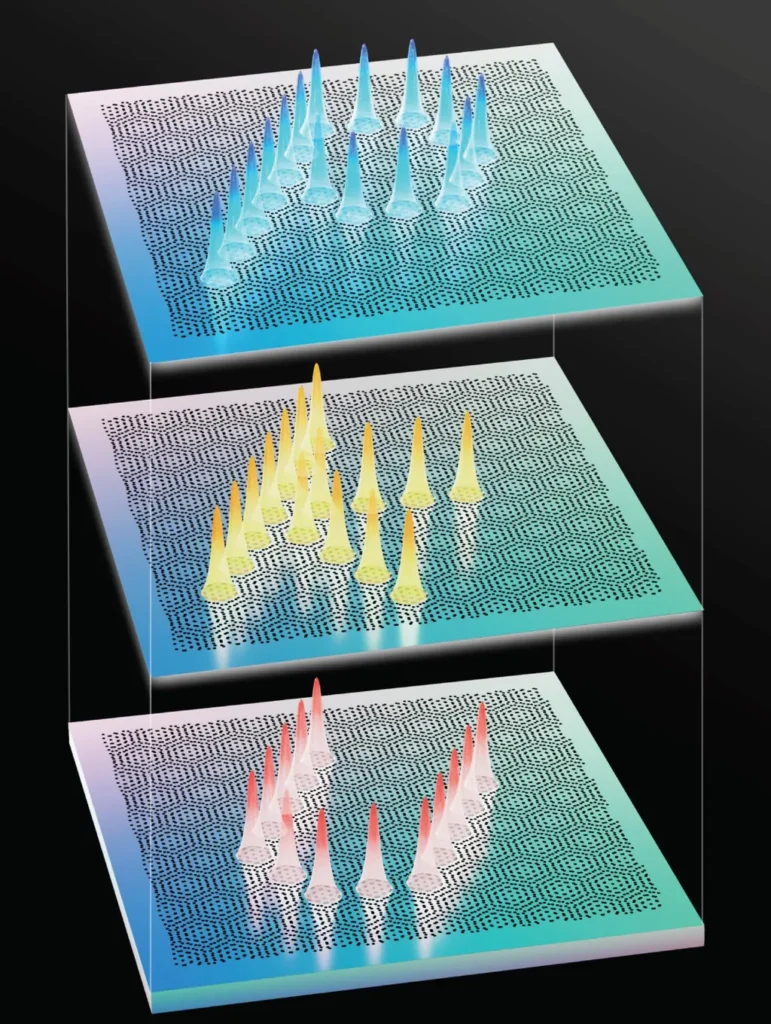
Researchers from the University of Central Florida, including Kaiwen Ji, Melissa Hedir, Qi Zhong, and Ramy El-Ganainy, along with collaborators Alejandro M. Yacomotti from the French National Center for Scientific Research and Li Ge from the University of British Columbia, have made significant strides in the development of nanolaser arrays. Their work, published in the journal Nature Photonics, explores the generation of twisted light using a unique arrangement of nanolasers on a photonic crystal membrane.
The team proposed and demonstrated an orbital angular momentum (OAM) nanolaser array arranged in a ring geometry. This configuration allows for a non-Hermitian extension of the Rice-Mele model, which features alternating coupling strengths and imaginary on-site detunings. The researchers found that this setup supports a symmetry-protected zero mode stabilized by non-Hermitian particle-hole symmetry. This symmetry enforces a uniform π/2 phase shift between adjacent nanolasers, creating a coherent phase winding around the array.
By adjusting the gain/loss contrast in a parity-time (PT)-like pumping scheme, the system can be tuned to a chiral exceptional point. At this point, energy flows unidirectionally between nanocavities despite their reciprocal coupling. This directional tunneling leads to far-field emission carrying non-zero OAM, providing a direct signature of the phase-structured lasing mode.
The practical applications of this research for the energy sector are significant. The ability to engineer compact, phase-locked laser arrays with controllable angular momentum output opens new avenues for structured light generation in integrated photonic platforms. This technology could be used to enhance data transmission rates, improve the efficiency of solar cells, and develop advanced sensing and imaging systems. The researchers’ results demonstrate a robust and scalable strategy for generating structured light, which could have far-reaching implications for the energy industry.
Source: Nature Photonics
This article is based on research available at arXiv.