
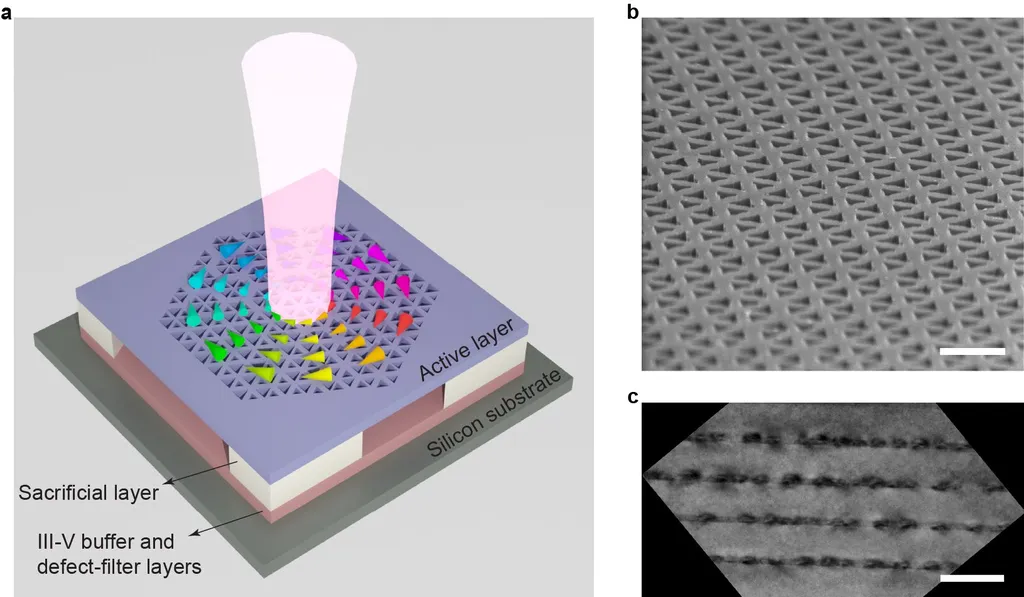
In the realm of energy research, a team of scientists from various institutions, including ITMO University, University of Stuttgart, and the Russian Quantum Center, has made a significant stride in understanding and manipulating a unique type of quasiparticle called Dirac exciton-polaritons. Their work, published in the journal Nature Photonics, opens up new avenues for potential applications in the energy sector, particularly in the development of advanced optoelectronic devices.
The researchers have demonstrated the ability to trap and control Dirac exciton-polaritons in a halide perovskite metasurface. This achievement is noteworthy because, traditionally, massless Dirac particles, which exhibit exceptional tunneling properties, have been considered difficult to trap due to a phenomenon known as the Klein paradox. However, this study extends the understanding of these particles beyond the conventional conservative framework into a non-Hermitian context.
The team achieved this by using spatially profiled nonresonant optical excitation and exciton-polariton interaction to create an effective non-Hermitian complex potential. This potential is responsible for the observed spatial binding and energy quantization of the Dirac exciton-polaritons. In simpler terms, they managed to confine these particles within a specific area and control their energy levels, which is a crucial step towards harnessing their unique properties for practical applications.
One of the most promising aspects of this research is the observation of multi-mode bosonic condensation of exciton-polaritons. This means that several bound states simultaneously achieve macroscopic occupation, a phenomenon that could be exploited to develop advanced light sources or highly efficient optoelectronic devices. The theoretical analysis conducted by the researchers, based on the driven-dissipative extension of the Dirac equation, further confirms the non-Hermitian character of the effective trap, allowing for confinement even in the case of gapless Dirac-like photonic dispersion.
The practical implications of this research for the energy sector are significant. The ability to trap and control Dirac exciton-polaritons could lead to the development of more efficient solar cells, advanced light-emitting devices, and other optoelectronic applications. By understanding and manipulating these quasiparticles, researchers can potentially unlock new ways to convert and manage energy, contributing to the ongoing efforts to create a more sustainable and efficient energy infrastructure.
In conclusion, the work of Mikhail Masharin, Igor Chestnov, Andrey Bochin, Pavel Kozhevin, Vanik Shahnazaryan, Alexey Yulin, Ivan Iorsh, Xuekai Ma, Stefan Schumacher, Sergey Makarov, Anton Samusev, and Anton Nalitov represents a significant advancement in the field of energy research. Their findings, published in Nature Photonics, provide a deeper understanding of Dirac exciton-polaritons and pave the way for innovative applications in the energy sector.
This article is based on research available at arXiv.