
In the realm of energy and mineral exploration, precise estimation of subterranean properties is crucial for efficient resource extraction and management. Researchers Anna Chlingaryan, Arman Melkumyan, and Raymond Leung from the University of Western Australia have developed a novel approach to improve the accuracy of these estimations. Their work, titled “IntegralGP: Volumetric estimation of subterranean geochemical properties in mineral deposits by fusing assay data with different spatial supports,” was published in the journal Computers & Geosciences.
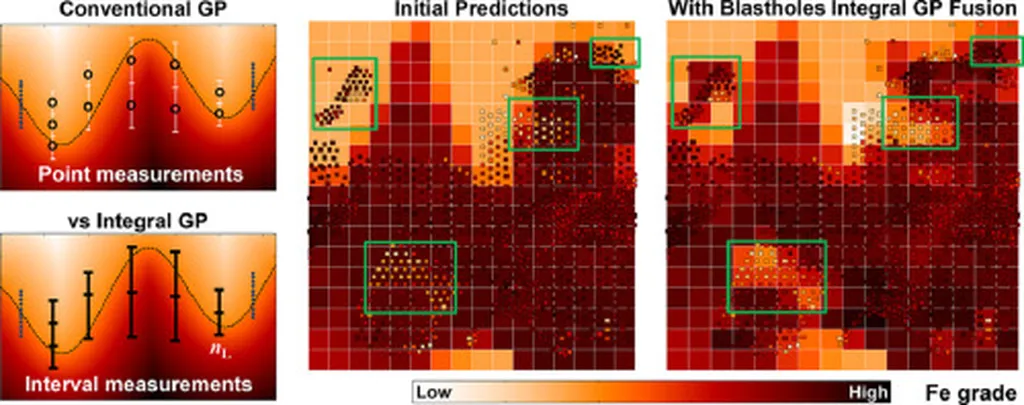
The team’s research focuses on enhancing the way geochemical data from blasthole assays is integrated and modeled. Blasthole assays are typically modeled as point observations, but this new method treats them as interval observations, which more accurately reflects their spatial support. This approach, known as Integral Gaussian Process (IntegralGP), provides a unified representation for data with different spatial supports, leading to improved regression performance and boundary delineation.
One of the key contributions of this research is the mathematical adjustments made to the covariance expressions, which enable the benefits of the IntegralGP framework. The researchers also obtained the gradient and anti-derivatives to facilitate the learning of kernel hyperparameters, addressing numerical stability issues that can arise in such complex models.
To demonstrate the practical application of their method, the team developed an IntegralGP data fusion algorithm. This algorithm aims to assimilate line-based blasthole assays and update a block model that predicts the concentration of iron (Fe) beneath the drilled bench. The researchers used a heteroscedastic Gaussian Process to fuse chemically compatible but spatially incongruous data with different resolutions and sample spacings. This ensures that domain knowledge embodied in the structure and empirical distribution of the block model is preserved while local inaccuracies are corrected.
The experiments conducted by the researchers showed that IntegralGP fusion improves bench-below grade prediction performance. For material classification, it reduces the absolute error and model bias, particularly in instances where waste blocks are mistakenly classified as high-grade. This improvement can lead to more accurate resource estimation and better decision-making in the energy and mining sectors.
In summary, the IntegralGP framework developed by Chlingaryan, Melkumyan, and Leung offers a more accurate and efficient way to model subterranean geochemical properties. This advancement can have significant practical applications in the energy industry, particularly in mineral exploration and extraction, where precise estimation of resources is essential for operational efficiency and sustainability.
This article is based on research available at arXiv.