
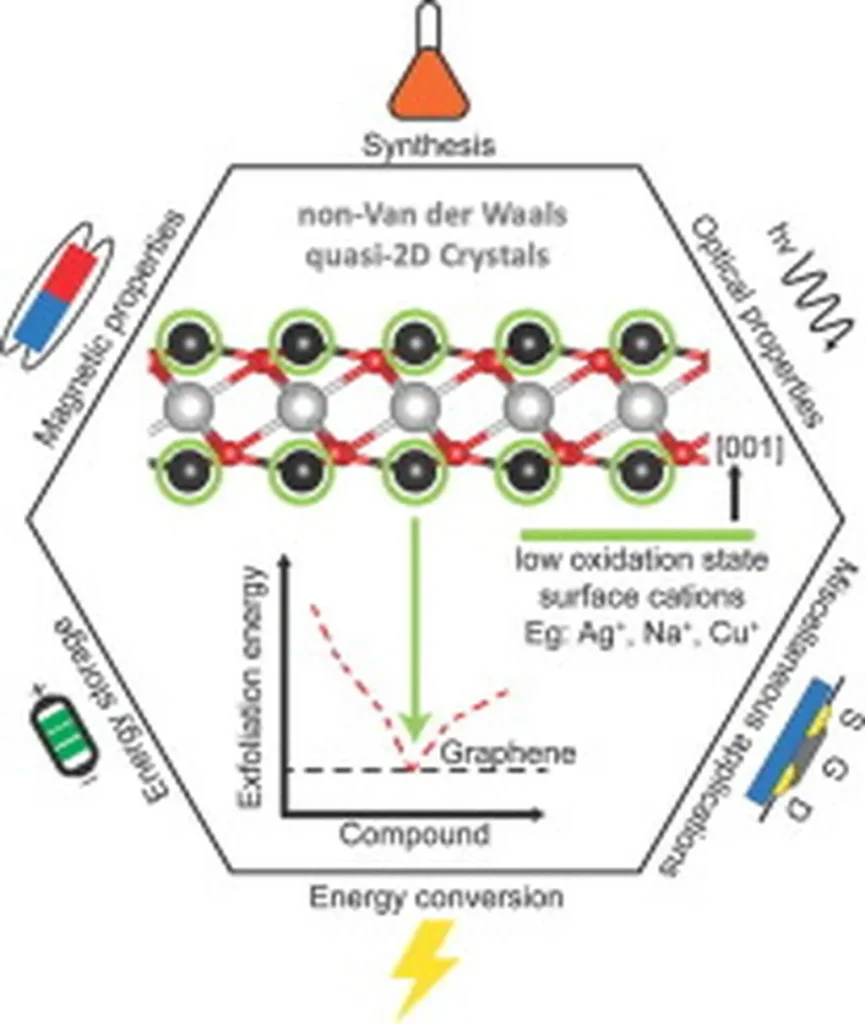
In the realm of energy and materials science, a team of researchers from various institutions, including Kazan Federal University and Texas Tech University, has made a notable advancement in the field of two-dimensional photonics. Their work focuses on expanding the range of materials used in this field beyond the currently dominant van der Waals (vdW) materials.
The research, published in the journal Nature Communications, introduces Na2Zn2TeO6 (NZTO), a non-vdW layered material, as a promising candidate for robust and functional two-dimensional photonics. The team discovered that NZTO can be exfoliated into few-nanometer thicknesses due to the highly disordered and mobile Na+ interlayer within its structure. This is a significant finding as non-vdW materials have typically been challenging to exfoliate.
NZTO’s optical properties were investigated using spectroscopic ellipsometry, revealing it to be a wide-bandgap dielectric with significant optical birefringence across the visible and near-infrared spectrum. This birefringence is a desirable property for various optical applications. The team also conducted temperature-resolved Raman spectroscopy to study the lattice dynamics of NZTO. They found that the [Zn2TeO6]2- framework of NZTO is rigid and largely decoupled from the high ionic mobility, indicating that NZTO could potentially offer both robust ionic conductivity and optical control.
The practical applications of this research for the energy sector are promising. The convergence of ionic transport and optical control, termed “iono-photonics” by the researchers, could lead to innovative energy storage and conversion devices. For instance, the unique properties of NZTO could be harnessed to develop more efficient and robust solar cells, sensors, or other optoelectronic devices. Moreover, the ability to exfoliate NZTO into thin layers opens up possibilities for flexible and lightweight energy devices.
In summary, this research expands the library of materials available for two-dimensional photonics, introducing a robust and functional non-vdW material with potential applications in the energy sector. The concept of iono-photonics presents an exciting new paradigm that could drive future innovations in energy technologies.
This article is based on research available at arXiv.