
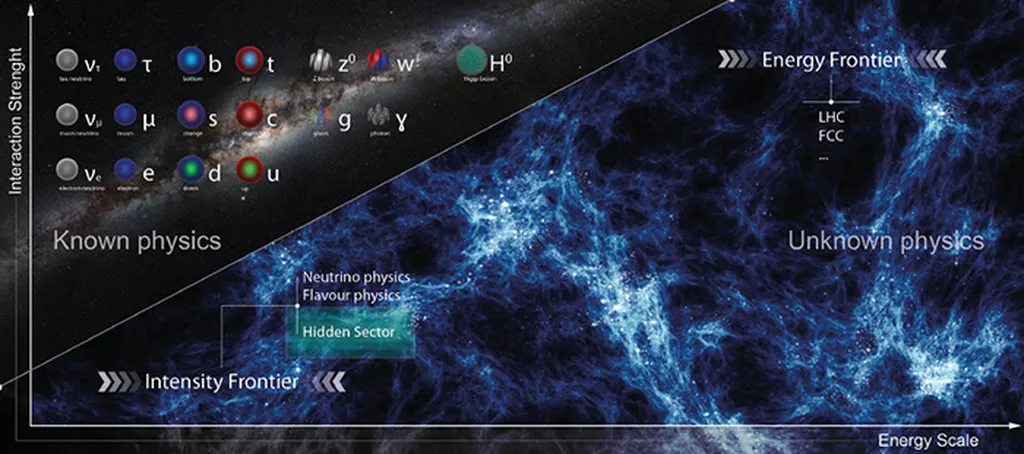
In the realm of energy and particle physics, a trio of researchers from the Max Planck Institute for Nuclear Physics in Heidelberg, Germany, have been delving into the potential of a phenomenon known as Coherent Elastic Neutrino-Nucleus Scattering (CEvNS) to probe for new physics beyond the Standard Model. The researchers, Salvador Centelles Chuliá, Manfred Lindner, and Thomas Rink, have been exploring how future CEvNS experiments could help detect deviations from the expected behavior of neutrinos, which might hint at the existence of additional, as-yet-undiscovered particles.
Neutrinos are tiny, neutral particles that are incredibly abundant in the universe, but they interact very weakly with other matter, making them difficult to detect and study. CEvNS is a process where a neutrino scatters off an entire nucleus, rather than an individual proton or neutron, and it was first experimentally confirmed using neutrinos from various sources, including nuclear reactors. The researchers are interested in how future, more precise measurements of CEvNS could be used to search for signs of new physics.
The researchers investigated two scenarios where deviations from the expected behavior of neutrinos might occur. In the first scenario, the “seesaw limit,” the new particles are so heavy that they are effectively invisible, but their presence still causes slight deviations in the behavior of the known neutrinos. In the second scenario, the “light sterile limit,” the new particles are light enough to be produced and detected, and they would participate in the same scattering processes as the known neutrinos.
The researchers showed how these scenarios would affect both CEvNS and another process called elastic neutrino-electron scattering (EνeS). They then projected the sensitivity of a future CEvNS reactor experiment, based on an upscaled version of the CONUS+ experiment, which recently reported the first observation of reactor CEvNS. They identified the key experimental challenges and demonstrated that such an experiment could potentially probe for new physics at the TeV scale, which is a billion times more energetic than the scale of everyday life.
The research highlights the strong potential of CEvNS to test the structure of the lepton sector, which includes particles like electrons and neutrinos, and to search for physics beyond the Standard Model. This could have implications for our understanding of the fundamental building blocks of the universe and could potentially lead to new discoveries in particle physics. The research was published in the journal Physical Review D.
For the energy industry, this research underscores the importance of nuclear reactors as a source of neutrinos for fundamental physics research. As nuclear power remains a significant part of the global energy mix, understanding these fundamental particles and their interactions can provide new insights and potential applications in energy production and safety. Moreover, the development of more sensitive neutrino detectors could lead to improved monitoring of nuclear reactors and enhanced safety measures.
This article is based on research available at arXiv.