
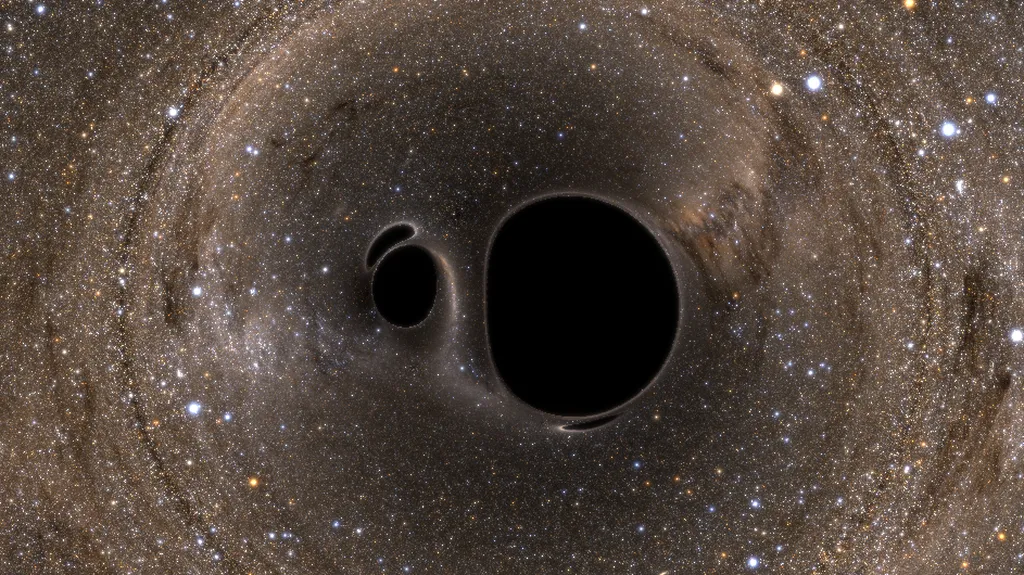
In the realm of astrophysics, a team of researchers led by Andrew Mummery from Columbia University, along with Brian Metzger, Sjoert van Velzen, and Muryel Guolo, has been delving into the mysteries of tidal disruption events (TDEs). These events occur when a star ventures too close to a supermassive black hole and is torn apart by the black hole’s immense gravitational forces, resulting in a bright optical/UV flare. The researchers’ findings, published in the journal Monthly Notices of the Royal Astronomical Society, shed light on the physical processes behind these spectacular cosmic phenomena.
Tidal disruption events are now commonly discovered as bright optical/UV flares, and their properties have been well categorized on a population level. The underlying physical processes that produce the evolution of their X-ray emission and their long-lasting UV/optical plateau are well understood. However, the origin of their early-time optical/UV emission has remained a subject of debate and uncertainty.
To address this, the researchers proposed and performed “Calorimetric” tests of published theories of these optical flares. They contrasted theoretical predictions for the scaling of the radiated energy and peak luminosity of these flares with black hole mass—something predicted by each theory—with the observed positive black hole mass scaling.
The findings revealed that no single theory provides a satisfactory description of observations across all black hole mass scales. However, theories related to the reprocessing of an Eddington-limited compact accretion disk, or the emission of energy released in the formation of a Keplerian disk near the circularization radius, performed best. These theories, however, require further extension to fully explain the observations.
On the other hand, models suggesting that the optical/UV flare is directly produced by shocks between debris streams, or the efficient reprocessing of the fallback rate, were ruled out at high significance by the data. These findings bring the scientific community closer to understanding the complex physics behind tidal disruption events, which, in turn, can inform our understanding of black hole behavior and the dynamics of galactic nuclei.
For the energy sector, while this research may not have direct practical applications, it contributes to the broader understanding of black hole physics and accretion processes. This knowledge can indirectly influence the development of energy technologies that harness nuclear fusion or other advanced energy sources, as well as improve our understanding of the fundamental forces and particles that govern the universe.
This article is based on research available at arXiv.