
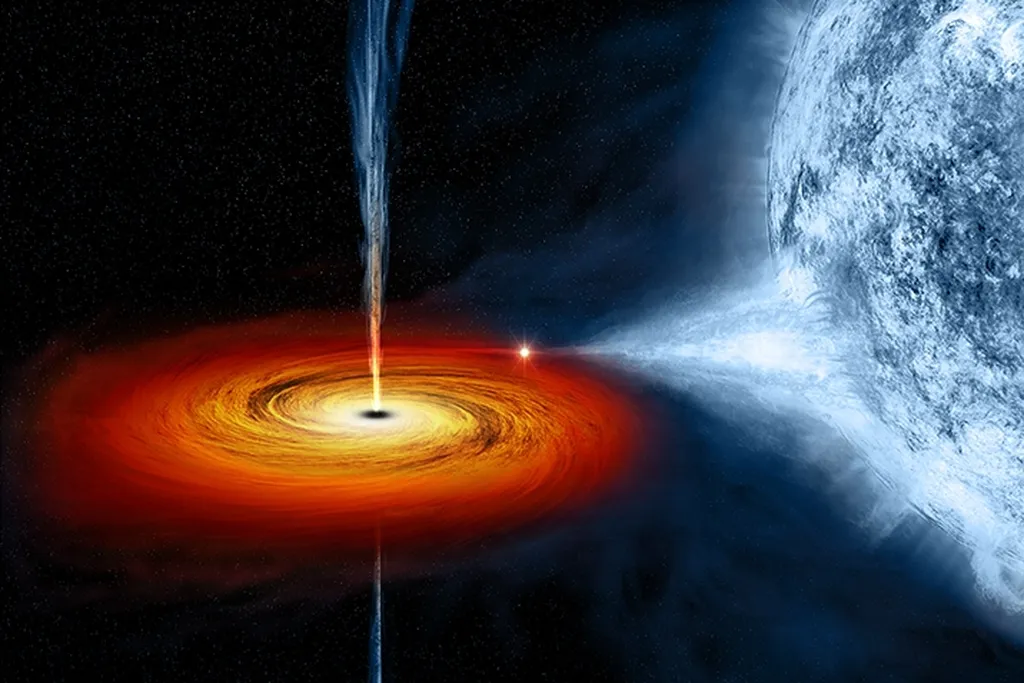
In a significant stride towards understanding the intricate dynamics of black hole systems, a team of researchers led by Steve Prabu from the International Centre for Radio Astronomy Research (ICRAR) and Curtin University, along with collaborators from various institutions, has unveiled new insights into the power of jets emitted by black holes. Their study, published in the journal Nature Astronomy, focuses on the black hole X-ray binary system Cygnus X-1, offering a clearer picture of the energetic processes at play.
The research team, which includes James C. A. Miller-Jones, Arash Bahramian, Valenti Bosch-Ramon, Sebastian Heinz, Steven J. Tingay, Callan M. Wood, Alexandra Tetarenko, Tyrone N. O’Doherty, and Valeriu Tudose, utilized 18 years of high-resolution radio imaging data to observe the interactions between the jets and the stellar wind in Cygnus X-1. This long-term observation allowed them to model the jet-wind interactions with unprecedented precision.
Jets are crucial for understanding the feedback mechanisms between black holes and their surrounding environments. These high-velocity streams of particles and radiation can influence the formation of large-scale structures in the universe, such as galaxies. Accurate measurements of jet power are essential for comprehending black hole growth through accretion and quantifying the impact of kinetic feedback. However, until now, direct measurements of instantaneous jet power have been lacking, forcing researchers to rely on assumptions about the energy released per accreted mass.
The study reports the detection of stellar wind-induced bending of the jets in Cygnus X-1. By analyzing this bending, the researchers were able to determine the current kinetic instantaneous power of the jet. Their findings indicate that the jet power is comparable to the accretion energy determined from the system’s bolometric X-ray luminosity. This result provides a firm empirical foundation for existing models of black hole-powered jets in galaxy formation simulations and scaling models of black hole accretion.
For the energy sector, this research offers valuable insights into the fundamental processes governing black hole systems, which are relevant to various astrophysical phenomena. Understanding the energetics of black hole jets can help refine models of energy distribution and feedback in the universe, potentially influencing our comprehension of cosmic energy dynamics. While the direct practical applications for the energy industry may not be immediate, the study contributes to the broader scientific understanding of high-energy astrophysical processes, which can indirectly inform energy-related research and technology development.
In summary, the research team’s findings represent a significant advancement in our understanding of black hole jet energetics. By providing empirical data on jet power, they have placed existing models on a more solid footing, paving the way for further advancements in both astrophysics and related fields. The study was published in the journal Nature Astronomy, offering a comprehensive overview of the research methodology and findings.
This article is based on research available at arXiv.