
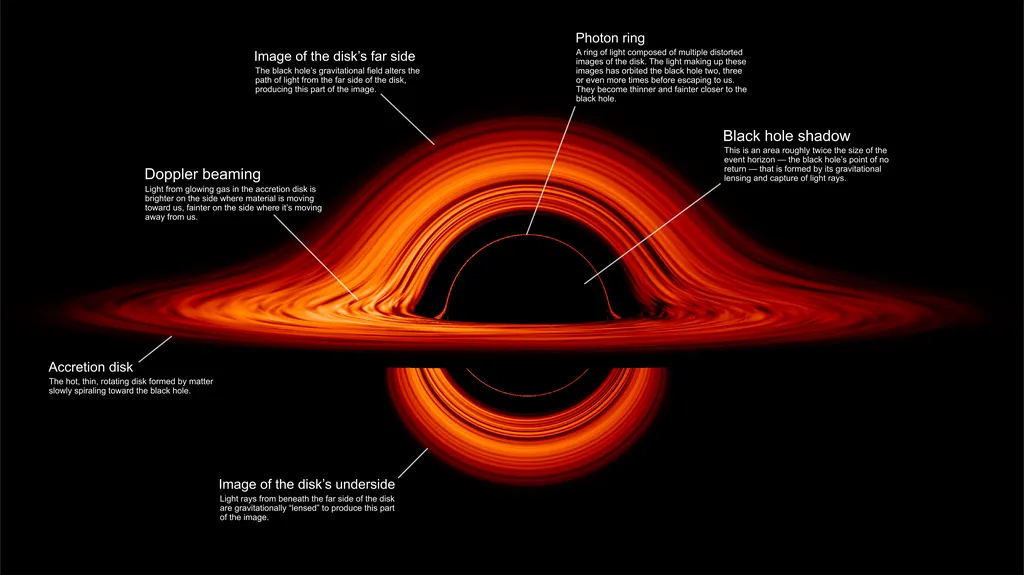
Researchers Mila Winter-Granic and Eliot Quataert from the University of California, Berkeley have developed a new model to understand the behavior of accretion disks around black holes, with potential implications for the energy sector’s understanding of extreme astrophysical events. Their work, published in the Monthly Notices of the Royal Astronomical Society, focuses on tidal disruption events (TDEs) and luminous fast blue optical transients (LFBOTs) like AT2018cow.
Accretion disks are vast, spinning structures of gas and dust that form around black holes as they consume nearby matter. In their study, Winter-Granic and Quataert present a time-dependent model that simulates the spread of these disks around black holes with masses ranging from 10 to 100 million times that of our Sun. The model incorporates several key factors, including outflows during super-Eddington accretion, non-conservation of mass and angular momentum in TDE circularization, and irradiation of the outer disk by the inner accretion flow.
One of the significant findings of this research is that many late-time plateaus in TDEs can be explained by disks formed with a large spread in angular momentum due to redistribution during circularization. This means that the disks do not need to spread viscously over year timescales to match observations, although this process is also compatible with the data. The researchers also found that the collapse of radiation pressure dominated thin disks to the stable gas-pressure dominated phase greatly underpredicts TDE plateau luminosities, strongly favoring thermally stable magnetically dominated disk models.
The study also highlights the importance of continued observation of late-time TDE emission, which provides a unique opportunity to constrain the physics of disk formation and circularization, disk warps, angular momentum transport, and other poorly understood aspects of disk physics. Additionally, the models developed in this research can explain the late-time optical-UV emission in the LFBOT AT2018cow for black hole masses of approximately 10-100 times that of our Sun. The faint X-ray emission at late times in AT2018cow is likely due to ongoing absorption, but the models predict that late-time X-rays should eventually be detectable again.
For the energy sector, understanding the behavior of accretion disks around black holes can provide insights into the extreme conditions that govern the physics of these cosmic engines. This knowledge can help inform the development of advanced energy technologies and contribute to our understanding of the fundamental processes that drive the universe. The researchers’ findings also underscore the importance of continued observation and study of these phenomena to deepen our understanding of the complex interplay between black holes and their surrounding accretion disks.
This article is based on research available at arXiv.