
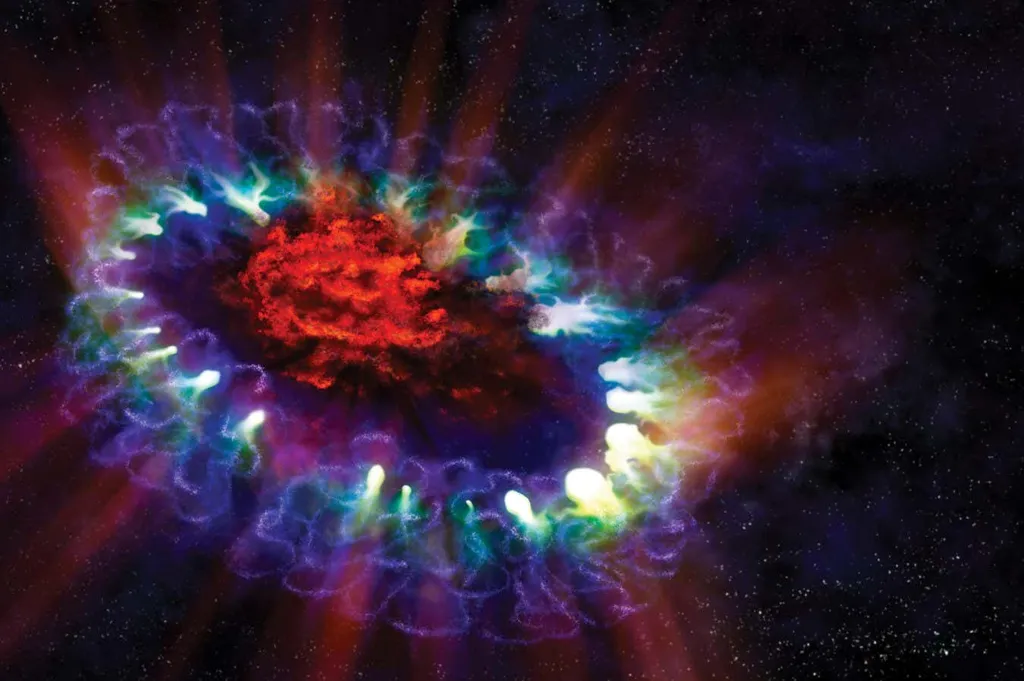
Researchers from the Weizmann Institute of Science, the California Institute of Technology, and other institutions have been investigating a potential link between a specific type of supernova and high-energy neutrinos, which could have significant implications for our understanding of cosmic rays and neutrino production.
The team, led by Dr. S. Garrappa and including prominent astrophysicists such as Prof. A. Gal-Yam from the Weizmann Institute of Science and Prof. E. O. Ofek from the California Institute of Technology, focused on a Type IIn supernova named SN2025cbj and its possible association with a high-energy neutrino detected by the IceCube Neutrino Observatory, named IceCube-250421A.
Type IIn supernovae are known for their strong interaction with circumstellar material (CSM), making them compelling candidates for efficient hadronic acceleration and neutrino production. The researchers combined rapid optical follow-up observations with archival photometry and spectroscopy to characterize the supernova’s evolution and its interaction with the surrounding material. They estimated the explosion and peak times from early light-curve fitting and quantified the chance-coincidence probability with resampling simulations.
The spectra of SN2025cbj obtained after the neutrino detection showed persistent narrow Balmer lines superposed on broad Lorentzian electron-scattering wings, consistent with sustained dense-CSM interaction. The resampling simulations against the Transient Name Server (TNS) catalog gave a chance-coincidence probability for observing one or more events of approximately 0.24, and approximately 0.078 against the ZTF-BTS catalog. These values are sensitive to the size of the supernova and neutrino samples.
Using a simple post-shock-breakout interaction model in a dense wind, the researchers estimated the expected muon-neutrino yield for the IceCube real-time Bronze stream. They predicted an expected yield of approximately 10^-3 events in the IceCube Bronze alert stream over 76 days per this one candidate. The researchers discussed the implications of these numbers and possible biases that may affect these results.
The practical applications for the energy sector, particularly in nuclear energy, could be significant. Understanding the origins of high-energy neutrinos and their association with supernovae can provide insights into the mechanisms of hadronic acceleration and neutrino production. This knowledge could potentially contribute to the development of advanced neutrino detection technologies and the improvement of nuclear reactor safety and monitoring systems.
The research was published in the journal Astronomy & Astrophysics.
This article is based on research available at arXiv.