
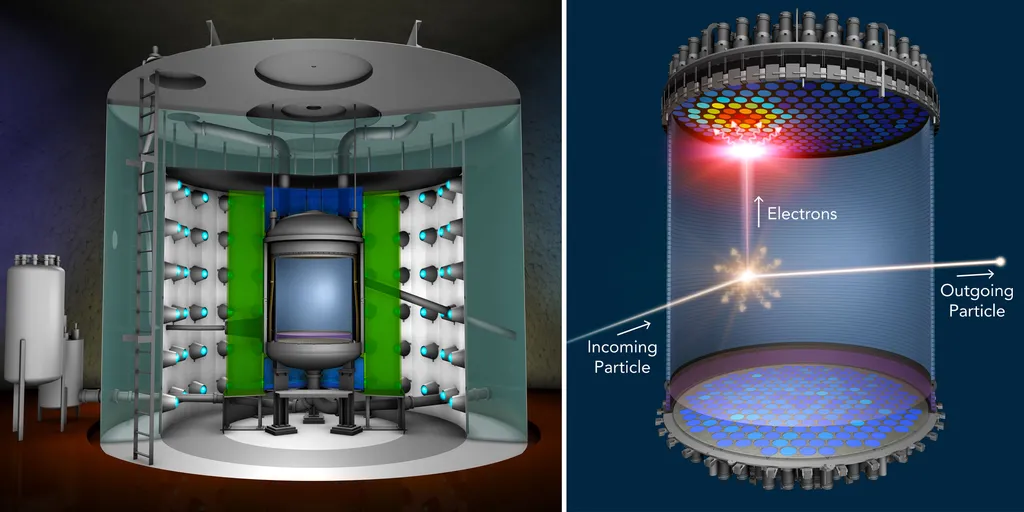
Researchers from the Institut de Física Corpuscular (IFIC) in Spain, led by Dr. J. J. Gómez-Cadenas, have proposed a novel approach to enhance the capabilities of gas xenon electroluminescent time projection chambers (GXeEL TPCs) used in neutrinoless double beta decay ($0νββ$) searches. These detectors are crucial for understanding fundamental particle physics and could have implications for energy production through advanced nuclear processes.
The team’s research, published in the journal [Physical Review Letters](https://journals.aps.org/prl/), focuses on improving the topological discrimination of events within these detectors. Currently, GXeEL TPCs can distinguish between single-electron and double-electron tracks, which is essential for identifying $0νββ$ decays. However, the diffusion of drifting electrons and the intrinsic blurring during electroluminescent (EL) amplification limit the fidelity of these tracks.
To address these limitations, the researchers propose introducing trace amounts of ammonia (NH₃) into the pure xenon gas. This addition converts xenon ions (Xe⁺) into ammonium ions (NH₄⁺) without affecting the EL process. An ion sensor positioned near the cathode captures these NH₄⁺ ions for events of interest. While electrons drift rapidly to the anode, producing the standard EL image, the NH₄⁺ ions drift slowly toward the cathode. This slow drift allows for the determination of the event energy and barycenter before laser interrogation of the sensor’s molecular layer reveals an ion-track image with sub-millimeter diffusion and no EL-induced smearing.
The combined electron-ion imaging significantly enhances topological discrimination, improving background rejection by about an order of magnitude. This advancement could substantially extend the discovery potential of GXeEL TPCs for very long $0νββ$ lifetimes, bringing us closer to understanding the fundamental nature of neutrinos and their role in the universe.
For the energy sector, this research could have practical applications in advanced nuclear technologies and particle detection systems used in energy research. Improved topological discrimination in detectors could lead to more precise measurements and better background rejection, enhancing the overall efficiency and accuracy of energy-related experiments.
This article is based on research available at arXiv.