
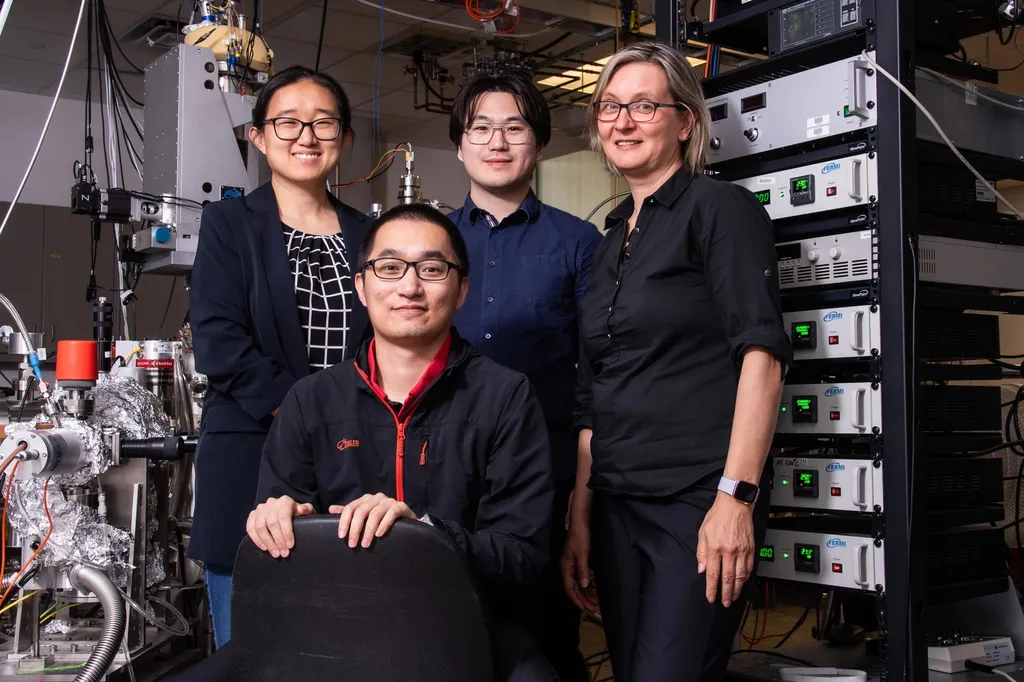
In the realm of energy research, a team of scientists from Rice University, led by Professor Randall G. Hulet, has made significant strides in understanding the behavior of one-dimensional (1D) Fermi gases with attractive interactions. Their work, published in the journal Nature Physics, delves into the low-energy excitations of these quantum systems, offering insights that could have practical applications in the energy sector, particularly in the development of advanced materials for energy storage and transfer.
The researchers, Aashish Kafle, Ruwan Senaratne, Danyel Cavazos-Cavazos, Hai-Ying Cui, Thierry Giamarchi, Han Pu, Xi-Wen Guan, and Randall G. Hulet, utilized a Feshbach resonance to access attractive interactions with lithium-6 (^6Li) atoms. This technique allows for precise control over the interaction strength between atoms, enabling the team to study the unique properties of 1D Fermi gases in the attractive regime.
In their study, the researchers measured the spin and charge dynamic structure factors using Bragg spectroscopy. They observed that, unlike in repulsive interactions, the spin wave propagates faster than the charge density wave in attractive interactions. This inversion of the classic spin-charge separation is a notable finding, as it highlights the distinct phenomena exhibited by quasi-1D fermions with attractive interactions, known as the Luther-Emery liquid.
Furthermore, the team discovered that a small spin polarization strongly suppresses the spin gap in the measured Bragg spectra. This observation provides valuable insights into the behavior of these quantum systems under varying conditions. Additionally, the researchers found evidence for pairing in the form of a reduction in spin correlations with increasing attraction and radio frequency (RF) spectra consistent with an atom/molecule mixture.
The practical applications of this research for the energy sector lie in the potential development of advanced materials with tailored properties. Understanding the behavior of 1D Fermi gases with attractive interactions can aid in the design of materials with enhanced energy storage and transfer capabilities. For instance, these insights could contribute to the development of more efficient batteries, superconductors, or other energy-related technologies.
In summary, the work of Hulet and his team at Rice University sheds light on the intriguing properties of 1D Fermi gases with attractive interactions. Their findings not only advance our fundamental understanding of these quantum systems but also pave the way for practical applications in the energy sector. As research in this area continues, we can expect further developments in the design and implementation of advanced energy technologies.
This article is based on research available at arXiv.