
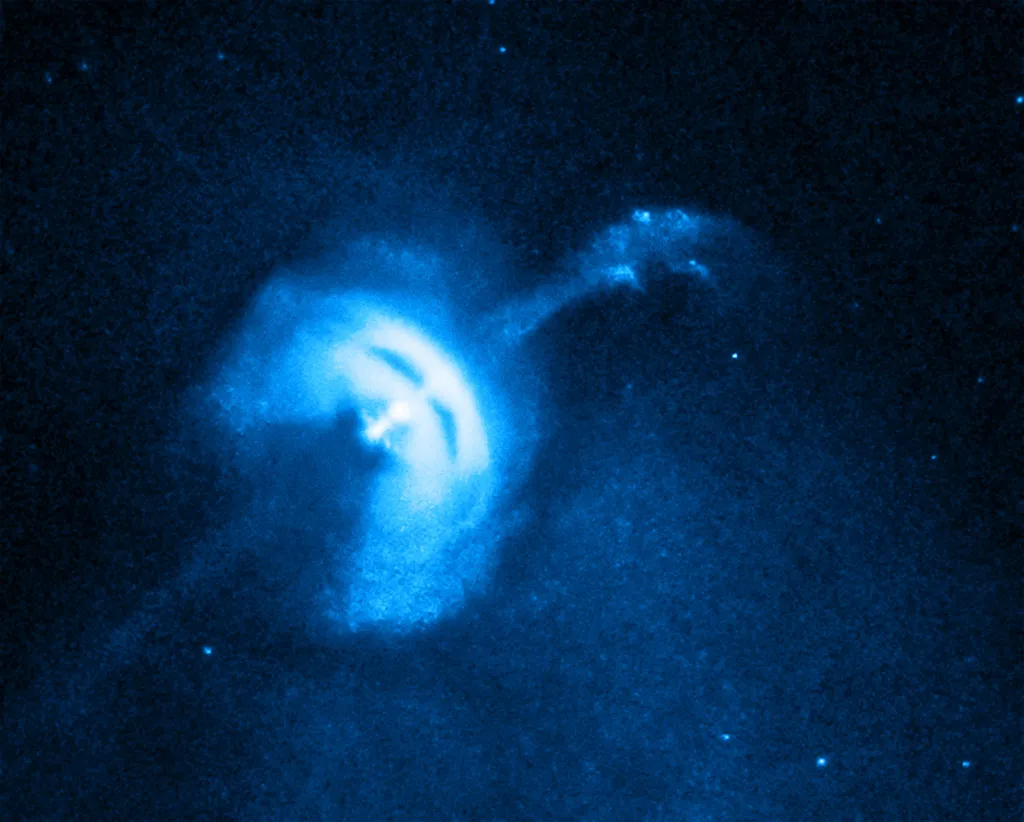
In the realm of astrophysics and energy research, a team of scientists led by Dr. Cole Miller from the University of Maryland, along with colleagues from various institutions including NASA’s Goddard Space Flight Center and the University of Illinois at Urbana-Champaign, have been delving into the mysteries of neutron stars. These researchers are part of the Neutron star Interior Composition Explorer (NICER) mission, which aims to study the dense remnants of exploded stars to better understand the fundamental physics that governs matter at extreme densities.
The team has recently focused their efforts on PSR J0437-4715, a type of neutron star known as a millisecond pulsar. Using data from NICER, they have been able to estimate the mass and radius of this celestial object. The research, published in The Astrophysical Journal Letters, highlights the importance of accurately modeling the various components of the pulsar’s emission to avoid biases in the resulting radius estimates.
Neutron stars like PSR J0437-4715 are incredibly dense, with masses comparable to that of the Sun but compressed into a sphere only about 20 kilometers in diameter. Understanding the properties of matter at such extreme densities is a key goal of both astrophysics and nuclear physics. The NICER data provides invaluable information about the properties of cold, catalyzed matter beyond nuclear saturation density, which is crucial for developing accurate equations of state for dense matter.
The researchers used several different models to analyze the NICER data, all of which included a modulated nonthermal component to the emission. Previous analyses had not accounted for this component, leading to poor fits to the bolometric NICER data. By including this component, the team found that the Bayesian evidence was significantly higher, indicating a more accurate model. Their headline model also included three uniform-temperature thermally-emitting circular spots on the stellar surface.
Using this model, the team estimated the radius of PSR J0437-4715 to be between 11.8 km and 15.1 km, with a mass of approximately 1.418 times that of the Sun. This measurement is consistent with previous reports of the radius of another neutron star, PSR J0030+0451, which has a similar mass. The implications of this measurement for the equation of state of dense matter are significant, as it provides a crucial constraint on the behavior of matter at extreme densities.
While this research may seem far removed from the energy industry, understanding the fundamental properties of matter at extreme densities can have practical applications. For example, the development of more accurate equations of state for dense matter can improve our understanding of nuclear reactions, which are at the heart of many energy production processes. Additionally, the technologies developed for space-based observatories like NICER can often be adapted for use in energy production and other industrial applications. As such, research into the fundamental properties of matter and the development of advanced observational technologies can have far-reaching impacts on a wide range of industries, including energy.
This article is based on research available at arXiv.